In today’s competitive real estate market, AI Virtual Staging vs 3D Rendering is one of the most searched comparisons among real estate agents, developers, home builders, architects, and property marketers. Both technologies help transform property marketing, but they serve different purposes and offer unique advantages. Understanding when to use AI virtual staging and when to invest in 3D rendering can help you attract more buyers, reduce marketing costs, and sell properties faster.
Whether you’re marketing an empty home, promoting a pre-construction development, or showcasing renovation possibilities, choosing the right visualization solution is essential. Platforms like PadStyler provide both AI-powered virtual staging and professional 3D rendering services, making it easy to create stunning property visuals that convert viewers into buyers.
Why Property Visualization Matters More Than Ever
Modern buyers begin their home search online. Before scheduling a viewing, they browse listing photos, compare properties, and imagine themselves living in the space.
Poor-quality or empty property photos often fail to create an emotional connection, while professionally enhanced visuals dramatically increase engagement.
Effective property visualization helps:
- Increase listing views
- Improve buyer confidence
- Reduce time on market
- Generate more qualified inquiries
- Enhance online marketing campaigns
- Increase perceived property value
This is where AI Virtual Staging and 3D Rendering become powerful marketing tools.
What is AI Virtual Staging?
AI Virtual Staging Creates Beautiful Interiors Instantly
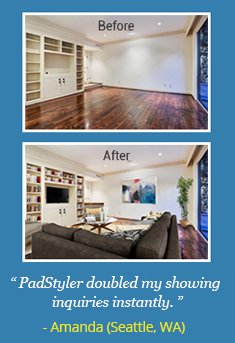
AI Virtual Staging uses artificial intelligence to digitally furnish and decorate existing photos of empty rooms.
Instead of physically renting furniture or hiring decorators, AI automatically transforms vacant spaces into attractive, fully furnished interiors within minutes.
For example, an empty living room can become:
- Modern contemporary
- Luxury design
- Scandinavian style
- Farmhouse
- Industrial
- Coastal
- Minimalist
The original structure remains exactly the same—the technology simply adds furniture, décor, lighting enhancements, rugs, artwork, and accessories.
PadStyler makes this process incredibly fast while maintaining realistic results.
Benefits of AI Virtual Staging
AI Virtual Staging Saves Time and Money
Compared to traditional staging, AI Virtual Staging offers several advantages.
Faster Delivery
Most AI-staged images are completed within minutes rather than days.
Lower Costs
No furniture rental.
No transportation.
No decorators.
No storage expenses.
Unlimited Design Options
Try multiple interior styles without moving a single piece of furniture.
Better Online Listings
Professionally staged images attract significantly more buyer attention.
Higher Buyer Engagement
People naturally connect with furnished spaces because they can visualize living there.
What is 3D Rendering?
3D Rendering Creates Properties Before They Exist
Unlike AI Virtual Staging, 3D Rendering creates an entirely new digital image from architectural plans, CAD drawings, floor plans, or design concepts.
Instead of modifying an existing photograph, 3D Rendering builds every element digitally, including:
- Walls
- Windows
- Floors
- Furniture
- Landscaping
- Lighting
- Textures
- Exterior finishes
- Architecture
The result is a realistic image of a property that may still be under construction—or may not even exist yet.
Benefits of 3D Rendering
Why Developers Choose 3D Rendering
3D rendering provides advantages that traditional photography simply cannot.
Pre-Sell Developments
Developers can begin marketing months before construction finishes.
Showcase Future Designs
Buyers can understand exactly how the completed project will look.
Improve Investor Presentations
Professional renderings increase confidence among investors and stakeholders.
Marketing Before Construction
Advertising campaigns can launch early.
Visualize Design Changes
Architects and clients can review multiple design options before construction begins.
AI Virtual Staging vs 3D Rendering: Key Differences
AI Virtual Staging vs 3D Rendering Comparison
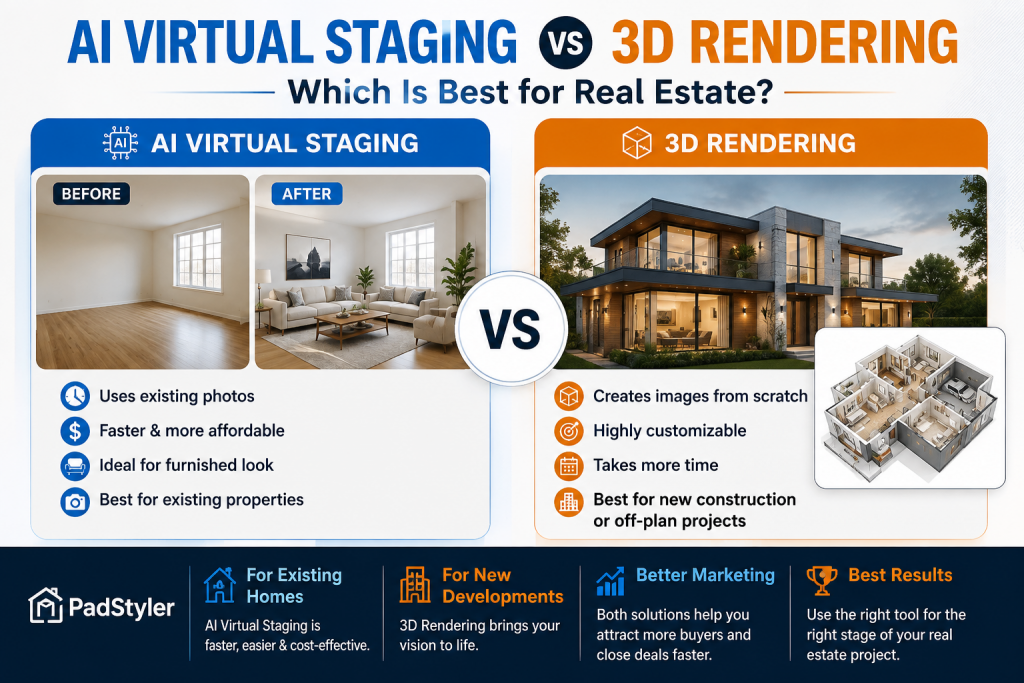
| Feature | AI Virtual Staging | 3D Rendering |
|---|---|---|
| Uses Existing Photos | Yes | No |
| Creates Images from Scratch | No | Yes |
| Best for Existing Homes | Yes | Limited |
| Best for New Construction | No | Yes |
| Turnaround Time | Minutes | Several Days |
| Cost | Lower | Higher |
| Interior Design Changes | Easy | Fully Customizable |
| Exterior Visualization | Limited | Excellent |
| Architectural Accuracy | Based on Existing Photo | Completely Designed |
| Marketing Stage | Ready Homes | Pre-Construction Projects |
When Should You Use AI Virtual Staging?
Best Uses for AI Virtual Staging
AI Virtual Staging is ideal when the property already exists but lacks visual appeal.
Perfect examples include:
Vacant Homes
Empty homes often feel smaller and less inviting.
Rental Properties
Create attractive listing photos without buying furniture.
Real Estate Listings
Improve MLS photos instantly.
Home Sellers
Increase perceived value before listing.
Property Investors
Market flipped homes quickly.
Airbnb Properties
Show decorating possibilities before final furnishing.
When Should You Use 3D Rendering?
Best Uses for 3D Rendering
3D rendering works best when construction has not yet been completed.
Common examples include:
Residential Developments
Market homes before they are built.
Apartment Projects
Sell units during construction.
Commercial Buildings
Show office layouts before completion.
Luxury Villas
Present premium architectural concepts.
Hotels
Create investor presentations.
Mixed-Use Developments
Visualize the entire project from multiple angles.
AI Virtual Staging vs 3D Rendering for Real Estate Agents
Real estate agents typically benefit more from AI Virtual Staging because most listings already exist.
Instead of photographing empty rooms, agents can create warm, inviting interiors that generate more clicks and more showings.
This approach delivers:
- Faster listing preparation
- Better online visibility
- Higher buyer engagement
- Lower marketing costs
- Improved first impressions
AI Virtual Staging vs 3D Rendering for Developers
Property developers usually rely on 3D Rendering because they need to market projects before construction is complete.
Developers use renderings for:
- Sales brochures
- Website marketing
- Billboards
- Investor presentations
- Social media campaigns
- Construction approvals
However, once the project is completed, AI Virtual Staging becomes useful for showcasing finished but unfurnished units.
Can You Use Both Together?
Combining AI Virtual Staging and 3D Rendering
Absolutely.
Many successful real estate companies combine both technologies.
A typical project looks like this:
Before Construction
Use 3D Rendering to market future homes.
During Construction
Update marketing with progress images.
After Completion
Use AI Virtual Staging to furnish actual property photos.
This creates a seamless marketing strategy throughout the property’s lifecycle.
Why AI Virtual Staging is Growing Faster
AI Technology is Transforming Property Marketing
AI Virtual Staging has become increasingly popular because it offers incredible speed and affordability.
Compared to traditional staging:
- Lower costs
- Faster turnaround
- Unlimited design styles
- Easy revisions
- Scalable for large portfolios
Real estate professionals managing multiple listings appreciate the ability to stage dozens of properties in a single day.
How PadStyler Makes Property Visualization Easy
PadStyler offers an all-in-one solution for modern real estate marketing by combining AI technology with professional visualization services.
With PadStyler, users can access:
- AI Virtual Staging
- Custom Virtual Staging
- AI Renovation Previews
- 3D Interior Rendering
- 3D Exterior Rendering
- Floor Plans
- Product Visualization
- High-quality marketing visuals
Whether you’re selling an existing home or launching a new development, PadStyler provides fast, realistic, and affordable visual solutions designed to help properties stand out in competitive markets.
Common Mistakes When Choosing Between AI Virtual Staging and 3D Rendering
Many professionals choose the wrong visualization method simply because they don’t understand the differences.
Common mistakes include:
- Using 3D Rendering for an already completed vacant home
- Using AI Virtual Staging for properties that haven’t been built
- Ignoring the target audience
- Focusing only on cost instead of marketing goals
- Using unrealistic designs that don’t match the property’s style
Selecting the right visualization tool ensures better marketing performance and a higher return on investment.
Future Trends in Property Visualization
Artificial intelligence continues to revolutionize real estate marketing.
Emerging trends include:
- Interactive AI staging
- Virtual walkthroughs
- Real-time room customization
- AI-generated renovation previews
- Personalized buyer visualization
- Augmented reality property experiences
As technology evolves, buyers will expect increasingly immersive and personalized viewing experiences before visiting a property in person.
Conclusion
The debate between AI Virtual Staging vs 3D Rendering isn’t about which technology is better—it’s about choosing the right solution for your specific project.
If you’re marketing an existing vacant property, AI Virtual Staging offers the fastest, most affordable, and most effective way to transform empty rooms into inviting living spaces. On the other hand, if you’re promoting a new development or showcasing a property that hasn’t been built yet, 3D Rendering delivers realistic visualizations that help buyers and investors understand the final vision.
For many real estate professionals, the ideal strategy is to combine both technologies throughout the property lifecycle. With PadStyler, you can access industry-leading AI Virtual Staging, professional 3D Rendering, renovation previews, and floor plan services—all designed to elevate your listings, engage buyers, and accelerate sales.