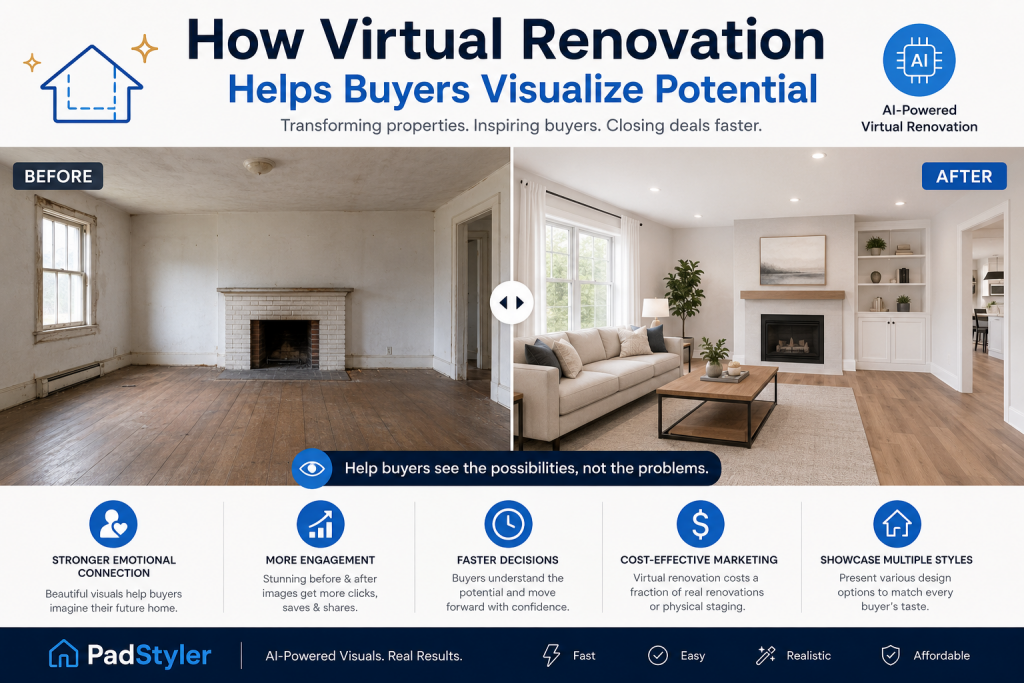
How Padstyler Virtual Renovation Helps Buyers Visualize Potential

The modern real estate market is more visual than ever. Buyers no longer rely only on imagination when walking through a property. Instead, they expect to see possibilities instantly. Empty rooms, outdated kitchens, old flooring, and worn-out walls can make it difficult for buyers to emotionally connect with a home. This is where virtual renovation has completely changed the game.

Today, AI-powered virtual renovation tools like PadStyler are helping real estate agents, brokers, homeowners, and property investors transform ordinary listing photos into visually stunning spaces without physical remodeling costs. Virtual renovation allows buyers to see what a property could look like after upgrades, helping them visualize the future potential of the home before making a purchasing decision.

In competitive real estate markets, first impressions determine whether buyers schedule a showing or move on to another listing. Virtual renovation creates emotional engagement instantly and gives properties a stronger online presence. It turns outdated homes into aspirational living spaces that buyers can connect with emotionally.

What Is Virtual Renovation?

Virtual renovation is a digital process that uses AI and advanced image editing technology to transform property photos into renovated versions of the same space. Instead of physically remodeling a home, virtual renovation creates realistic visual representations of improvements such as new flooring, modern kitchens, updated paint colors, renovated bathrooms, improved lighting, and redesigned interiors.

Unlike traditional home staging or remodeling, virtual renovation is fast, affordable, and highly scalable. Real estate professionals can showcase multiple renovation styles for a single property, helping buyers understand how the home can be customized to fit their lifestyle.

Virtual Renovation vs Traditional Renovation

Feature Virtual Renovation Traditional Renovation
Cost Low Very High
Time Required Hours Weeks or Months
Flexibility Unlimited Design Options Limited After Completion
Risk None Construction Risks
Marketing Speed Instant Listing Updates Delayed Listings
Buyer Visualization Excellent Depends on Finished Work

This comparison clearly shows why AI-powered virtual renovation is becoming one of the most valuable tools in modern real estate marketing.


Why Buyers Struggle to Visualize Potential

Many buyers have difficulty imagining what a home could become. This is especially true when properties are empty, outdated, cluttered, or poorly maintained. Buyers often focus on visible flaws instead of hidden opportunities.

A dated kitchen may discourage interest even if the layout is perfect. Old carpet can distract buyers from a spacious floor plan. Dark walls and outdated furniture can make a property feel smaller and less inviting.

Most buyers are not interior designers. They cannot always mentally remove outdated features or imagine renovation possibilities during a property tour. As a result, many great homes get overlooked simply because buyers cannot visualize the transformation.

Virtual renovation solves this problem by showing buyers a finished vision instantly.


How Virtual Renovation Creates Emotional Connection

Real estate decisions are highly emotional. Buyers purchase homes based on how a property makes them feel. A beautifully renovated virtual image creates excitement, inspiration, and aspiration.

When buyers view a virtually renovated home, they stop focusing on flaws and start imagining their future lifestyle inside the property. They can see modern kitchens where they will cook family meals, stylish living rooms for entertaining guests, and relaxing bedrooms that feel comfortable and luxurious.

This emotional connection increases buyer engagement and creates stronger interest in the listing.

Emotional Impact of Virtual Renovation

Buyer Reaction Without Virtual Renovation Buyer Reaction With Virtual Renovation
Sees outdated rooms Sees modern possibilities
Focuses on repairs Focuses on lifestyle
Feels uncertain Feels inspired
Scrolls past listing Saves and shares listing
Hesitates to schedule showing Books viewing faster

Properties that create emotional engagement typically generate more inquiries, more showings, and stronger offers.


The Role of AI in Virtual Renovation

Artificial intelligence has transformed virtual renovation from a slow manual editing process into an instant marketing solution. AI-powered platforms analyze room structures, lighting, layouts, and design styles to create realistic renovations automatically.

Modern AI renovation tools can:

  • Replace outdated flooring
  • Remodel kitchens digitally
  • Add modern lighting
  • Upgrade furniture styles
  • Change wall colors
  • Modernize bathrooms
  • Enhance landscaping
  • Create multiple design variations

AI allows real estate agents to generate high-quality renovated visuals within minutes instead of waiting days for manual editing.

Platforms like PadStyler are helping agents scale property marketing faster while reducing costs dramatically.


Virtual Renovation Helps Listings Stand Out Online

The majority of buyers begin their home search online. Listing photos determine whether a buyer clicks on a property or skips to the next option.

In crowded real estate marketplaces, visually appealing listings gain more visibility and engagement. Virtual renovation helps outdated properties compete against newer homes by presenting an upgraded vision.

Benefits for Online Listings

Listing Challenge Virtual Renovation Solution
Empty rooms feel cold Add modern furniture and decor
Outdated interiors reduce clicks Show contemporary renovations
Poor lighting looks unattractive Brighten and enhance rooms
Buyers overlook potential Showcase future possibilities
Low engagement online Increase clicks and shares

Properties with attractive visuals often receive significantly more attention across real estate websites and social media platforms.


Helping Buyers Understand Renovation Possibilities

One of the biggest advantages of virtual renovation is education. Buyers can better understand what upgrades are possible within a property.

For example, a buyer may not realize how much larger a kitchen could feel after cabinet updates and brighter finishes. Virtual renovation removes uncertainty and gives buyers clarity.

This is especially important for:

  • First-time homebuyers
  • Investment property buyers
  • Fix-and-flip investors
  • Luxury property shoppers
  • Relocation buyers

Instead of relying on imagination alone, buyers can see realistic renovation outcomes before making decisions.

Virtual Renovation Increases Buyer Confidence

Homebuyers often fear renovation costs and uncertainty. Many worry about whether improvements will actually look good after construction.

Virtual renovation reduces this hesitation by providing visual reassurance. Buyers gain confidence because they can clearly see the transformation before committing financially.

How Virtual Renovation Reduces Buyer Anxiety

Common Buyer Concern How Virtual Renovation Helps
“This home looks outdated.” Shows modern upgraded design
“I can’t picture the space.” Provides realistic visual layouts
“Renovation seems overwhelming.” Simplifies the vision process
“I don’t know if it’s worth it.” Demonstrates property potential
“I’m unsure about investment value.” Highlights future appeal

Confident buyers are more likely to move forward quickly and make competitive offers.

Virtual Renovation for Real Estate Agents

Real estate agents are increasingly using AI virtual renovation to improve listing performance and attract more clients.

Sellers want agents who can market homes effectively. Offering virtual renovation services gives agents a strong competitive advantage and positions them as technology-forward professionals.

Advantages for Real Estate Professionals


Faster Property Sales

Visually upgraded listings generate more buyer interest and reduce time on market.

Better Listing Presentations

Agents can show sellers how virtual renovation will improve marketing results before listing the property.

More Social Media Engagement

Renovated visuals perform exceptionally well on platforms like Instagram, Facebook, and Pinterest.

Reduced Marketing Costs

Virtual renovation eliminates the need for expensive physical staging and remodeling.

Higher Perceived Property Value

Updated visuals can increase buyer perception of value and desirability.

Virtual Renovation for Fixer-Uppers

Fixer-upper properties are often difficult to market because buyers focus heavily on current condition instead of future potential.

Virtual renovation transforms distressed properties into attractive opportunities by showing buyers the end result.

Before and After Marketing Impact

Fixer-Upper Without Virtual Renovation Fixer-Upper With Virtual Renovation
Appears risky Appears full of opportunity
Receives fewer showings Attracts more buyer interest
Harder to price competitively Easier to justify value
Buyers underestimate possibilities Buyers see renovation vision
Longer selling time Faster decision-making

This strategy is especially effective for investors and agents selling older homes.

Virtual Renovation and Luxury Real Estate

Luxury buyers expect premium presentation. Even high-end homes can benefit from virtual renovation if interiors appear outdated.

Luxury real estate marketing often uses virtual renovation to:

  • Modernize expensive properties
  • Showcase designer concepts
  • Present multiple aesthetic styles
  • Appeal to international buyers
  • Create magazine-quality visuals

High-end buyers are drawn to properties that already reflect luxury living. Virtual renovation creates that emotional experience instantly.


The Power of Multiple Design Styles

Every buyer has different design preferences. Some prefer modern minimalism, while others like farmhouse, Scandinavian, industrial, or luxury interiors.

Virtual renovation allows agents to present multiple styles for the same property.

Popular Virtual Renovation Styles

Design Style Buyer Appeal
Modern Minimalist Young professionals
Farmhouse Families and suburban buyers
Scandinavian Contemporary buyers
Luxury Contemporary High-end market
Industrial Urban buyers
Coastal Vacation home shoppers

Showing multiple possibilities helps properties appeal to broader audiences.

Virtual Renovation Improves Social Media Marketing

Real estate marketing is increasingly driven by visual platforms. Listings with dramatic transformations perform exceptionally well on social media.

Before-and-after renovation content generates:

  • More clicks
  • More shares
  • More comments
  • More listing inquiries
  • Better brand visibility

AI-generated renovations create highly engaging content for:

  • Instagram Reels
  • Facebook Ads
  • Pinterest Boards
  • TikTok Videos
  • Real Estate Blogs

This expanded reach helps agents attract both buyers and future sellers.

Why Buyers Trust Visual Experiences

Modern consumers are influenced heavily by visual proof. Buyers want to see possibilities instead of imagining them abstractly.

Virtual renovation creates realistic experiences that feel tangible and believable. When executed correctly using advanced AI technology, the renovated visuals appear authentic and inspiring.

High-quality virtual renovation helps buyers:

  • Understand room dimensions
  • Visualize furniture placement
  • Evaluate renovation possibilities
  • Compare design styles
  • Feel emotionally connected

The more realistic the presentation, the more powerful the buyer response becomes. Continue reading
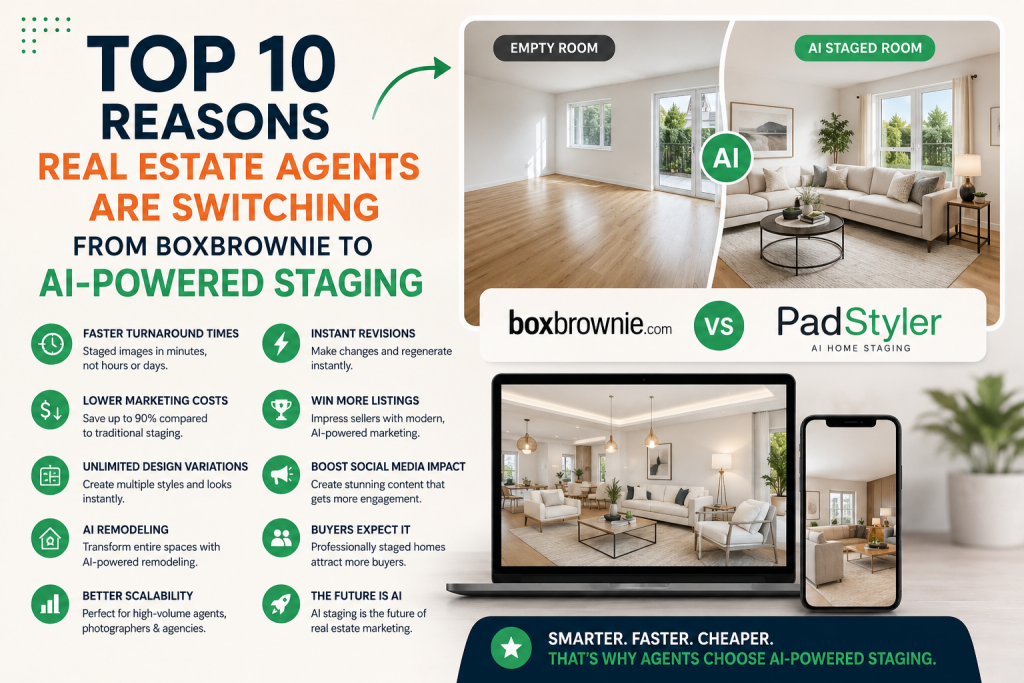
Top 10 Reasons Real Estate Agents Are Switching from BoxBrownie to AI-Powered Staging

The real estate industry is changing faster than ever. Buyers now expect visually stunning listings before they even consider booking a showing. In today’s digital-first market, the quality of listing photos can directly influence clicks, inquiries, showings, and ultimately sales. Because of this shift, real estate agents are rapidly moving away from traditional photo editing services like BoxBrownie and embracing AI-powered staging platforms such as PadStyler.

AI virtual staging is no longer just a trend. It has become one of the most important marketing tools in modern real estate. Agents want faster turnaround times, lower costs, unlimited revisions, and the ability to create stunning interiors instantly. Traditional editing workflows are struggling to keep up with the speed and scale required in competitive markets.

This is why thousands of agents, brokers, photographers, and property marketers are switching from manual staging services to AI-driven real estate visualization tools. AI staging platforms are helping agents save money, market listings faster, improve online engagement, and win more listings.

In this article, we will explore the top 10 reasons real estate professionals are making the transition from BoxBrownie to AI-powered staging platforms like PadStyler and why AI is shaping the future of property marketing.

The Rise of AI Virtual Staging in Real Estate

Over the past few years, artificial intelligence has transformed industries across the world, and real estate marketing is no exception. Traditional virtual staging once required designers or editors to manually place furniture into listing photos. While the results could look professional, the process was often expensive, slow, and difficult to scale.

AI-powered staging completely changes that process.

Instead of waiting 24 to 48 hours for edits, agents can now upload a property photo and receive beautifully staged images within minutes. AI can redesign rooms, replace furniture, create remodeling previews, and generate multiple design styles instantly.

This shift toward automation is one of the biggest reasons agents are moving away from manual editing services. According to industry comparisons, AI staging tools now offer significantly faster turnaround times and dramatically lower costs than traditional editing providers. (PhotoFounder)

1. Faster Turnaround Times

Speed matters in real estate.

When a property hits the market, agents want listings live immediately. Delays in photography or editing can cost valuable buyer attention during the first few days of a listing.

Traditional editing platforms like BoxBrownie often require 24 to 48 hours to complete virtual staging because most edits rely on human designers. (PhotoFounder)

AI-powered staging platforms like PadStyler can generate staged photos within minutes.

This speed gives agents a major competitive advantage. Instead of waiting days, they can:

  • Publish listings faster
  • Launch marketing campaigns immediately
  • Post on social media the same day
  • Respond to seller expectations quickly
  • Create instant design variations

Many agents now prioritize speed over traditional manual workflows because the modern market moves rapidly. Reddit discussions among photographers and agents consistently highlight “instant revisions” and “same-day marketing” as major reasons for switching to AI staging. (Reddit)

2. Lower Marketing Costs

One of the biggest reasons agents are abandoning manual virtual staging is cost.

Traditional staging services can become extremely expensive, especially for agents managing multiple listings each month. Human-edited services often charge per image, with costs ranging from $24 to $32 per photo. (PhotoFounder)

For larger listings, costs add up quickly.

A typical vacant property may require:

  • Living room staging
  • Bedroom staging
  • Dining room staging
  • Kitchen enhancement
  • Home office visualization

An agent could easily spend hundreds of dollars on a single listing.

AI staging platforms dramatically reduce these expenses through subscription-based models and automated generation systems. Some AI solutions reduce costs by more than 90% compared to manual editing services. (Stager Go)

This affordability allows agents to stage more listings without increasing marketing budgets.

3. Unlimited Design Variations

Traditional virtual staging often limits creativity because every revision costs money and requires additional waiting time.

AI staging changes that completely.

With AI-powered platforms, agents can instantly generate multiple room styles, including:

  • Modern interiors
  • Luxury staging
  • Scandinavian design
  • Minimalist aesthetics
  • Farmhouse concepts
  • Contemporary layouts

This flexibility helps agents better target specific buyer demographics.

For example:

  • Luxury buyers may respond to elegant staging
  • Young professionals may prefer modern minimalism
  • Families may connect with warm traditional interiors

Instead of paying for multiple edits, agents can instantly test different styles until they find the best fit.

This capability is becoming one of the biggest competitive advantages of AI staging.

4. AI Remodeling Is Changing Property Marketing

One of the most exciting developments in real estate marketing is AI remodeling.

Traditional virtual staging only adds furniture to empty rooms. AI remodeling goes much further.

Platforms like PadStyler can digitally transform entire spaces by:

  • Changing flooring
  • Updating wall colors
  • Redesigning kitchens
  • Remodeling bathrooms
  • Modernizing outdated interiors
  • Creating renovation previews

This technology is especially powerful for:

  • Home flippers
  • Investors
  • Realtors selling outdated homes
  • Remodeling contractors
  • Property developers

Buyers often struggle to visualize renovation potential. AI remodeling solves this problem instantly by showing realistic transformations before any physical work begins.

Traditional editing platforms typically do not provide the same level of automated remodeling capabilities. (PadStyler)

5. Better Scalability for High-Volume Agents

Modern agents handle more listings, more content, and more marketing channels than ever before.

This creates a major challenge with traditional editing services.

Manual staging workflows simply do not scale efficiently for:

  • Large brokerages
  • Real estate marketing agencies
  • Airbnb managers
  • Property management companies
  • Real estate photographers

AI-powered platforms solve this issue by allowing users to create unlimited staging visuals quickly and affordably.

Instead of paying per image and waiting for edits, agents can produce content at scale.

This is particularly important in competitive housing markets where speed and volume directly impact visibility.

6. Instant Revisions Improve Workflow

One of the biggest frustrations with traditional staging services is revision time.

If a seller dislikes the furniture style or an agent wants a different look, the process starts over again. This creates delays, communication issues, and workflow bottlenecks.

AI staging platforms eliminate this problem.

Agents can regenerate visuals instantly without:

  • Sending revision requests
  • Waiting another 24 hours
  • Paying extra editing fees
  • Managing long email threads

Many photographers and marketers now consider instant revisions one of the most valuable benefits of AI staging. Industry discussions repeatedly mention how eliminating “vendor wait time” dramatically improves efficiency. (Reddit)

7. AI Staging Helps Agents Win More Listings

Listing presentations are becoming increasingly competitive.

Sellers want agents who offer modern marketing strategies and advanced technology.

Agents using AI-powered staging can impress potential clients by showing:

  • Before-and-after transformations
  • AI remodeling previews
  • Multiple room styles
  • Luxury interior concepts
  • Fast listing preparation

This creates a powerful “wow factor” during presentations.

Instead of simply promising marketing results, agents can visually demonstrate how they will transform listing photos into high-converting marketing assets.

This technological advantage helps agents stand out from competitors who still rely on traditional workflows. Continue reading


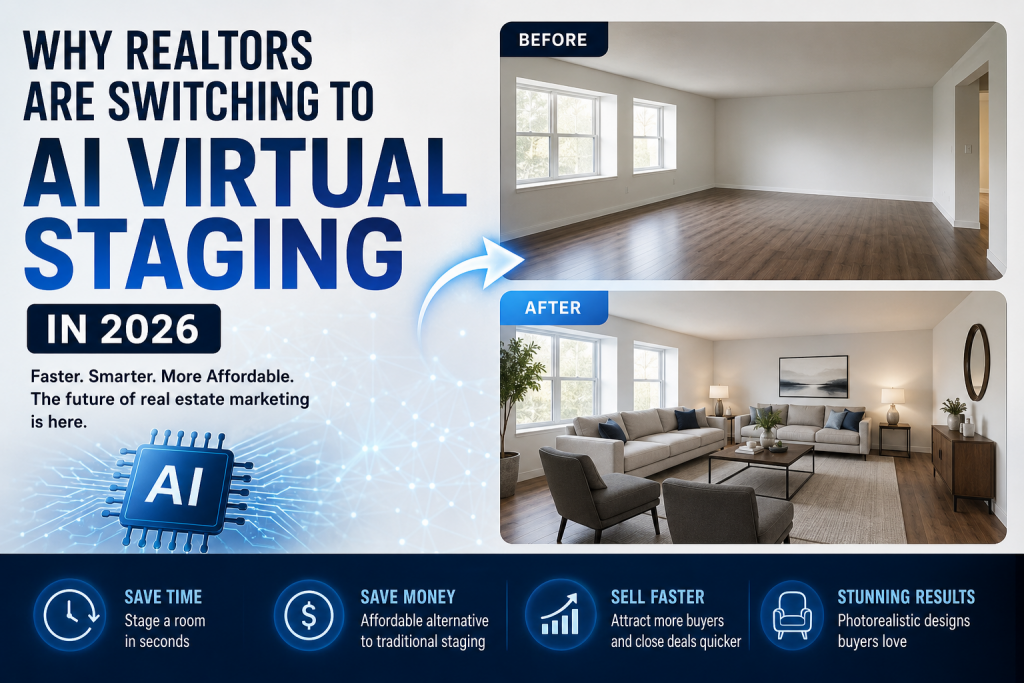
Why Realtors Are Switching to AI Virtual Staging in 202

The real estate industry is changing faster than ever, and 2026 is becoming the year where artificial intelligence transforms how properties are marketed online. Buyers now expect visually appealing listings, faster responses, and immersive digital experiences before they even schedule a showing. Because of this shift, more real estate professionals are turning toward AI virtual staging to stay competitive in a crowded housing market.

Traditional marketing methods are no longer enough to capture buyer attention. Empty rooms feel cold and uninspiring, while physical staging often costs thousands of dollars and takes days or even weeks to complete. Realtors need a faster, more affordable, and scalable solution that helps listings stand out instantly. This is exactly why AI virtual staging has become one of the biggest trends in modern real estate marketing.

Platforms like PadStyler are helping agents transform vacant or outdated properties into visually stunning homes within minutes. AI-powered staging technology allows Realtors to redesign interiors digitally, create multiple design styles, and attract buyers online without the expense of traditional staging companies.

In 2026, Realtors are not just experimenting with AI staging anymore. They are fully adopting it as a core marketing strategy. From luxury brokers to independent agents, the industry is recognizing that AI-generated visuals increase engagement, improve listing performance, and help homes sell faster.

The Rise of AI in Real Estate Marketing

Artificial intelligence is now deeply integrated into the real estate industry. Agents use AI tools for lead generation, customer communication, property valuation, market analysis, and content creation. Virtual staging is one of the fastest-growing segments because it directly impacts how buyers emotionally connect with a property.

Modern buyers start their home search online. Most purchasing decisions begin with scrolling through listing photos on websites and mobile apps. If the visuals fail to capture attention within a few seconds, buyers simply move on to another listing.

This behavior has pushed Realtors to rethink their marketing strategies. Empty rooms no longer perform well in digital marketplaces because buyers struggle to visualize the potential of the space. AI virtual staging solves this problem by creating warm, furnished, and professionally designed interiors that help buyers imagine themselves living in the home.

The ability to generate realistic staging instantly has completely changed how agents market properties. Instead of waiting for furniture delivery, staging teams, and photographers, Realtors can now upload an image and receive a beautifully staged version almost immediately.

This speed is becoming a major competitive advantage in 2026.

Why Traditional Staging Is Losing Popularity

Traditional staging still has value for certain luxury properties and high-end showings, but many Realtors are moving away from it because of the high costs and logistical challenges involved.

Physical staging requires furniture rentals, transportation, setup crews, decorators, and scheduling coordination. Depending on the size of the property, staging can cost thousands of dollars every month. For many agents, especially those handling multiple listings, these expenses quickly become difficult to justify.

In contrast, AI virtual staging provides similar visual impact at a fraction of the cost. Realtors can digitally furnish an entire property without moving a single piece of furniture. This makes it easier to market vacant homes, rental units, investment properties, and renovation projects.

Another issue with traditional staging is time. In fast-moving markets, agents cannot afford delays. Waiting several days for staging installation can slow down listing launches and reduce momentum. AI staging eliminates these delays completely.

Realtors in 2026 prioritize speed, flexibility, and return on investment. AI virtual staging delivers all three.

AI Virtual Staging Creates Stronger First Impressions

First impressions matter more than ever in online real estate marketing. Buyers form opinions about a property within seconds of viewing listing photos. A visually appealing image immediately creates emotional interest and encourages buyers to explore further.

AI virtual staging transforms plain rooms into aspirational living spaces. Empty bedrooms become cozy retreats. Vacant living rooms turn into stylish entertainment areas. Outdated interiors appear modern and inviting.

This emotional connection is critical because buyers do not simply purchase square footage. They purchase a lifestyle.

Well-designed staged images help buyers visualize how furniture fits into a room, how lighting enhances the atmosphere, and how the home can support their daily lives. These visuals increase engagement, generate more clicks, and lead to higher-quality inquiries.

Properties with professionally staged images consistently outperform empty listings online because they attract more attention across real estate platforms and social media channels.

Faster Listing Preparation Gives Realtors an Advantage

In competitive markets, timing can determine whether a property receives immediate interest or sits unnoticed online.

AI virtual staging dramatically reduces preparation time for new listings. Realtors no longer need to coordinate photographers, furniture companies, and decorators before launching a property. Instead, they can upload photos and generate staged images within minutes.

This speed helps agents market homes faster while maintaining professional presentation quality.

In 2026, many Realtors handle larger listing volumes and rely on automation to improve efficiency. AI staging allows them to streamline operations without sacrificing visual quality.

Properties can also be customized quickly for different buyer demographics. A single room can be staged in modern, luxury, minimalist, Scandinavian, or family-friendly styles depending on the target audience.

This flexibility gives Realtors a powerful marketing advantage.

AI Staging Helps Listings Perform Better Online

Online visibility is one of the biggest priorities in modern real estate marketing. Listings compete against thousands of other properties across major platforms, and visual presentation often determines which homes receive attention.

AI virtual staging helps increase listing engagement because staged photos are more attractive in search results, social media posts, email campaigns, and digital advertisements.

Buyers are naturally drawn toward visually polished homes. This increased attention leads to more property views, longer browsing times, and higher inquiry rates.

In many cases, staged listings also receive more shares on social media platforms, which expands exposure organically.

Realtors using AI-generated visuals often notice improvements in click-through rates and overall marketing performance because the images immediately stand out from competing listings.

Buyers Expect Better Digital Experiences in 2026

Consumer expectations have evolved significantly over the last few years. Modern buyers are accustomed to high-quality digital experiences across every industry, including real estate.

They expect listings to feel immersive, polished, and professionally presented. Basic property photos are no longer enough.

AI virtual staging meets these expectations by creating realistic interiors that resemble professionally designed homes. Buyers can better understand room functionality, layout possibilities, and design potential.

This is especially important for younger buyers who rely heavily on online research before scheduling property tours.

Millennial and Gen Z buyers respond strongly to visually engaging content because they spend large amounts of time consuming digital media on platforms like Instagram, YouTube, and TikTok.

Realtors who embrace AI staging are aligning their marketing strategies with modern buyer behavior.

Cost Efficiency Is Driving Industry Adoption

One of the biggest reasons Realtors are switching to AI virtual staging in 2026 is simple: cost savings.

Traditional staging expenses can significantly reduce profitability, especially for mid-range properties or investment listings. AI staging provides a more affordable alternative while still delivering impressive visual results.

Agents can stage multiple rooms for a small fraction of the cost of physical furniture rentals. This makes professional marketing accessible even for smaller agencies and independent Realtors.

Cost efficiency also allows agents to experiment with multiple design styles without additional financial risk. Instead of committing to one staging setup, they can create several versions tailored to different audiences.

This flexibility improves marketing performance while keeping expenses under control.

AI Staging Supports Remote Real Estate Sales

Remote buying activity continues to grow in 2026. Many buyers relocate across states or countries and rely heavily on digital property tours before making decisions.

AI virtual staging improves remote property marketing because it creates visually engaging spaces that help online buyers understand the home better.

Vacant properties often appear smaller and less inviting in photos. AI-generated furnishings solve this issue by adding scale, warmth, and personality.

For international buyers and investors, strong visuals are especially important because they may not visit the property in person until much later in the transaction process.

Realtors who use AI staging can market homes more effectively to remote audiences and expand their reach beyond local buyers.

Social Media Marketing Is Fueling AI Staging Growth

Social media has become one of the most powerful marketing channels for Realtors. Platforms like Instagram, Facebook, LinkedIn, and TikTok heavily prioritize visual content.

AI virtual staging helps agents create eye-catching property posts that generate engagement and attract potential clients.

Before-and-after transformations are particularly popular because they immediately showcase the power of AI design technology. These posts often receive strong interaction rates, which increases brand visibility for Realtors.

Social media algorithms favor visually compelling content, and staged property images perform far better than empty rooms.

Agents who consistently share AI-enhanced listings position themselves as innovative, tech-forward professionals.

This modern branding helps Realtors attract both buyers and sellers in competitive markets.

AI Helps Realtors Win More Listings

Homeowners want agents who can market their properties effectively. In listing presentations, Realtors who demonstrate advanced AI marketing capabilities often gain a significant advantage over competitors.

Showing sellers how their vacant or outdated property can be transformed digitally creates excitement and confidence.

Sellers recognize that professional visuals improve buyer interest and increase perceived property value.

AI virtual staging also allows Realtors to present renovation possibilities for outdated homes. Instead of focusing on flaws, agents can show potential.

This ability to visualize transformation helps sellers see the marketing value immediately.

In 2026, AI-powered marketing is becoming a differentiator that helps Realtors secure more listings and build stronger client trust.

AI Virtual Staging Improves Perceived Property Value

Presentation influences perception. A well-designed room feels more valuable, more functional, and more desirable.

AI staging enhances property presentation by creating modern, stylish interiors that appeal to buyer emotions. This improved presentation often increases perceived value even before buyers schedule a showing.

When buyers emotionally connect with a property online, they are more likely to book tours quickly and submit competitive offers.

Professionally staged visuals also help properties appear move-in ready, which reduces buyer hesitation.

In highly competitive markets, these psychological advantages can significantly impact sales performance. Continue reading


PadStyler vs BoxBrownie: Which Virtual Staging Platform Is Better for Real Estate in 2026?

The real estate industry has evolved into a highly visual and digital-first marketplace. Buyers no longer depend only on physical visits to decide whether a property is worth considering. Today, the first impression happens online through listing photos, social media posts, virtual tours, and AI-generated property visuals.

Because of this shift, virtual staging has become one of the most important marketing tools for modern real estate agents.

Properties that look professionally designed tend to generate more clicks, more engagement, and more buyer inquiries. Empty rooms feel cold and difficult to imagine, while beautifully staged interiors help buyers emotionally connect with a property.

This growing demand for visually enhanced listings has pushed platforms like PadStyler and BoxBrownie into the spotlight.

Both platforms help real estate professionals improve listing images, but they operate very differently.

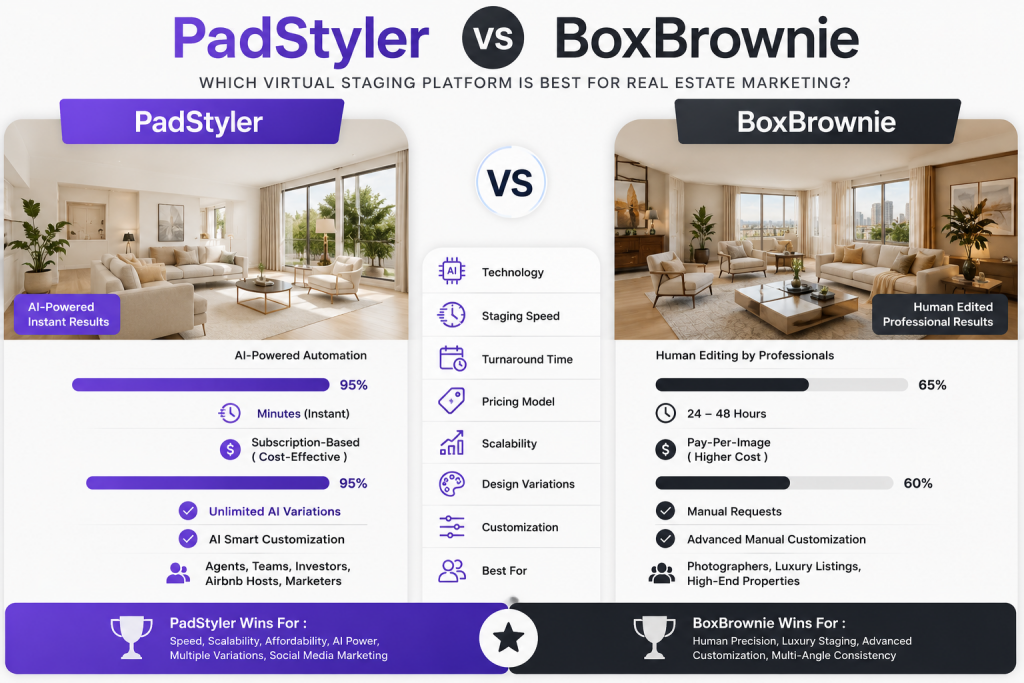
PadStyler focuses heavily on AI-powered automation and instant content generation, while BoxBrownie relies more on professional human editors and traditional virtual staging workflows.

So which platform is actually better for modern real estate marketing?


In this detailed comparison, we will break down:

  • AI capabilities
  • Virtual staging quality
  • Turnaround speed
  • Pricing structure
  • Scalability
  • Realtor branding potential
  • Social media advantages
  • Marketing ROI
  • Best use cases for each platform

If you are a realtor, investor, photographer, Airbnb host, or property marketer, this guide will help you choose the right solution for your business.


Understanding the Rise of Virtual Staging

Before comparing both platforms, it is important to understand why virtual staging has become such a powerful marketing tool.

Traditional home staging can cost thousands of dollars.

Furniture rentals, decorators, movers, and installation expenses make physical staging difficult for many agents and homeowners.

Virtual staging solves this problem by digitally furnishing rooms instead of physically decorating them.

The results are faster, cheaper, and easier to scale.

Now AI is taking virtual staging even further.

Instead of relying completely on human editors, AI-powered platforms can instantly redesign rooms, add furniture, generate remodel concepts, and create multiple style variations within minutes.

This is where the difference between PadStyler and BoxBrownie becomes very important.


What Is PadStyler?

PadStyler is an AI-powered real estate visualization platform designed to help agents create high-quality property marketing visuals instantly.

The platform focuses on speed, automation, and scalability.

Instead of waiting days for human editors, users can upload listing photos and receive AI-enhanced designs within minutes.

PadStyler offers features such as:

  • AI virtual staging
  • AI remodeling previews
  • Furniture replacement
  • Interior redesign
  • Exterior enhancement
  • Style transformation
  • Luxury room concepts
  • Instant rendering
  • Before-and-after staging

One of the biggest advantages of PadStyler is its ability to generate multiple design concepts quickly.

Agents can experiment with different aesthetics such as:

  • Luxury modern
  • Scandinavian
  • Contemporary
  • Farmhouse
  • Minimalist
  • Industrial

This flexibility makes PadStyler highly useful for real estate professionals who need large amounts of marketing content regularly.


What Is BoxBrownie?

BoxBrownie is one of the most recognized virtual staging and real estate photo editing companies in the industry.

Unlike AI-first platforms, BoxBrownie relies primarily on professional human editors.

The company offers services such as:

  • Virtual staging
  • Image enhancement
  • Day-to-dusk conversion
  • Item removal
  • Floor plans
  • CGI rendering
  • Virtual renovation
  • Commercial editing

BoxBrownie has been trusted by many real estate photographers and agencies for years because of its polished editing quality and consistent results.

However, the workflow is significantly different from AI-powered systems.

Since human designers manually work on projects, delivery times are slower and costs can increase for agents handling many listings monthly.


The Core Difference Between PadStyler and BoxBrownie

The main difference comes down to technology.


PadStyler = AI Automation

PadStyler uses artificial intelligence to automate staging and room transformation.

This allows users to:

✔ Generate visuals instantly
✔ Create multiple room styles quickly
✔ Scale listing marketing faster
✔ Produce social media content daily
✔ Reduce staging costs significantly

The AI workflow is designed for speed and efficiency.


BoxBrownie = Human Editing

BoxBrownie focuses more on traditional manual editing by professional designers.

This provides:

✔ Human-level customization
✔ Detailed furniture placement
✔ Advanced realism
✔ Consistent room angles

However, the process usually takes longer and costs more per image.


Feature Comparison Chart

Feature PadStyler BoxBrownie
AI Virtual Staging ✔ Yes Limited
Human Editors Minimal ✔ Yes
Instant Results ✔ Yes ✘ No
Multiple Design Variations ✔ Instant Manual Requests
Turnaround Speed Minutes 24–48 Hours
Subscription Pricing ✔ Yes Mostly Pay-Per-Image
Scalability Excellent Moderate
Social Media Content Creation Excellent Good
AI Remodeling ✔ Yes Limited
Best For Fast AI marketing Premium manual edits


Speed Comparison: Why Turnaround Time Matters

In real estate, speed can directly affect sales performance.

Listings often need to go live quickly.

Agents cannot always wait several days for edited visuals.

This is one of the biggest reasons AI staging platforms are becoming more popular.


PadStyler Speed Advantage

PadStyler delivers AI-generated staging within minutes.

This creates several advantages for agents:


Faster Listing Launches

Properties can be marketed immediately after photography sessions.


Same-Day Social Media Content

Agents can instantly create Instagram posts, Facebook ads, and listing promotions.


Quick Style Testing

Users can test multiple furniture styles without extra delays.


Faster Client Approvals

Sellers can review several design concepts quickly.


Visual Performance Bar

PadStyler Speed Efficiency

████████████████████ 95%

BoxBrownie Speed Efficiency

████████████ 60%

BoxBrownie Turnaround Time

Because BoxBrownie depends on human editors, delivery usually takes 24–48 hours.

While this may still be fast compared to physical staging, it is slower than AI-generated systems.

For luxury listings, this may not be a major issue.

But for agents handling many listings weekly, delays can reduce marketing efficiency.


Pricing Comparison

Pricing plays a huge role in platform selection.

Especially for agents managing multiple properties every month.


PadStyler Pricing Structure

PadStyler focuses on scalable AI-powered subscriptions.

Advantages include:

✔ Lower long-term costs
✔ Unlimited content generation
✔ Better scalability
✔ Faster experimentation
✔ Cost-effective for teams

Instead of paying for every image individually, agents can generate large amounts of content under monthly plans.

This is highly beneficial for:

  • High-volume realtors
  • Airbnb managers
  • Marketing agencies
  • Real estate teams
  • Property investors

Continue reading


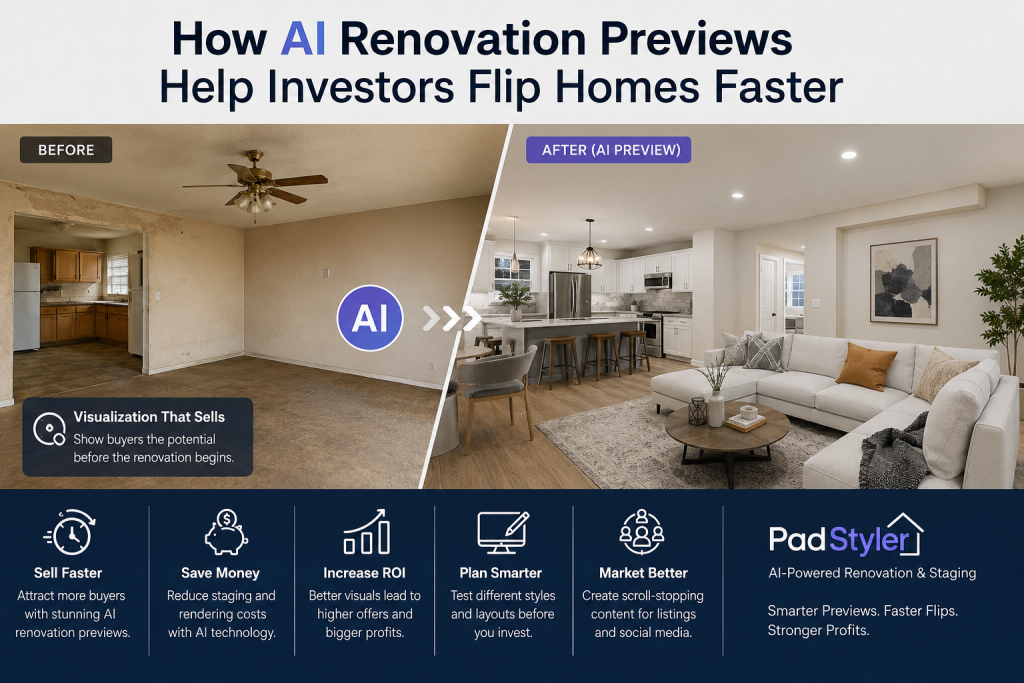
How AI Renovation Previews Help Investors Flip Homes Faster

The real estate investment market has become more competitive than ever. Property investors are constantly searching for ways to renovate faster, market smarter, reduce holding costs, and close deals before competitors enter the market.

In today’s digital-first housing market, buyers make decisions quickly. Most buyers scroll through listings online before they ever schedule a showing. If a property looks outdated, empty, or visually uninspiring, potential buyers move on within seconds.

This is where AI renovation previews are transforming the real estate industry.

Modern investors are no longer relying solely on physical renovations, expensive staging, or lengthy design consultations. Instead, they are using AI-powered renovation previews to show buyers exactly what a property could become before major work is completed.

Platforms like PadStyler are helping real estate investors create realistic renovation visualizations, modern staging concepts, and marketing-ready property images that dramatically improve buyer engagement.

For house flippers, this technology is becoming one of the most powerful tools for accelerating sales and maximizing return on investment.

What Are AI Renovation Previews?

AI renovation previews are digitally generated property transformations powered by artificial intelligence. These previews show realistic “after renovation” versions of homes using advanced image processing and design automation.

Instead of imagining how a property might look after upgrades, buyers can instantly see remodeled kitchens, modern living rooms, updated bathrooms, new flooring, enhanced lighting, and redesigned exteriors.

The process is fast, affordable, and scalable.

Traditional architectural renderings often require designers, manual edits, lengthy revisions, and high production costs. AI tools simplify this process dramatically.

With AI renovation technology, investors can:

  • Showcase remodeled spaces before construction begins
  • Visualize multiple design styles instantly
  • Create modern staging concepts
  • Generate marketing images within hours
  • Test renovation ideas before spending capital
  • Increase listing engagement online

For real estate investors flipping homes, these benefits directly impact profitability and speed.

Why Speed Matters in House Flipping

Successful property flipping depends heavily on timing.

Every extra week a property remains unsold increases carrying costs. Investors continue paying:

  • Mortgage payments
  • Property taxes
  • Insurance
  • Utilities
  • Maintenance expenses
  • Interest costs
  • Marketing costs

The longer the holding period, the lower the overall profit margin.

This is why investors focus intensely on reducing time-to-sale.

AI renovation previews help shorten the sales cycle by making properties visually attractive earlier in the process.

Instead of waiting for complete renovations, investors can begin marketing immediately with AI-generated previews.

This creates momentum long before physical construction is finalized.

The Psychology Behind Buyer Decision-Making

Most homebuyers struggle with visualization.

An outdated property with old flooring, damaged walls, poor lighting, or empty rooms often feels emotionally disconnected. Buyers cannot easily imagine the final result.

This creates hesitation.

AI renovation previews solve this problem by helping buyers emotionally connect with the property instantly.

When buyers see a beautifully renovated kitchen or a modern staged living room, they begin imagining themselves living in the space.

That emotional connection increases buyer interest dramatically.

In many cases, buyers become willing to pay higher prices because the transformation already feels tangible and realistic.

For investors, this means:

  • More listing clicks
  • More showing requests
  • More buyer inquiries
  • Faster offers
  • Higher perceived property value

How AI Renovation Previews Reduce Renovation Risk

One of the biggest challenges in real estate investing is uncertainty.

Investors constantly ask questions such as:

  • Which renovation style will attract buyers?
  • Should the kitchen be modern or traditional?
  • Will open-concept layouts perform better?
  • Which flooring style increases resale value?
  • What color palettes appeal most to local buyers?

Making the wrong renovation decisions can reduce profit margins significantly.

AI renovation previews allow investors to test visual concepts before investing heavily in construction.

Instead of relying purely on assumptions, investors can preview multiple renovation styles digitally and evaluate which designs create the strongest visual impact.

This leads to smarter renovation planning and more strategic budget allocation.

AI Renovation Previews Improve Listing Performance

Online listings are the first impression for most buyers.

In highly competitive real estate markets, professional visuals are essential.

Listings with poor photography or outdated interiors often receive fewer clicks and lower engagement.

AI-enhanced renovation previews help investors create visually striking listings that stand out immediately.

Professionally enhanced property images can increase:

  • Click-through rates
  • Time spent on listings
  • Social media shares
  • Buyer inquiries
  • Showing requests

More visibility means more opportunities to sell quickly.

For investors flipping homes, better marketing directly translates into faster transactions.

Virtual Staging Benefits for Real Estate Investors

Virtual staging has become one of the most important tools in modern property marketing.

Empty homes often feel cold and uninviting. Buyers struggle to understand room functionality, furniture placement, and scale.

AI virtual staging solves this issue instantly.

Using platforms like PadStyler, investors can transform empty rooms into fully furnished, professionally designed spaces without physically staging the property.

This provides several major advantages.

Lower Staging Costs

Traditional staging can cost thousands of dollars per property.

Furniture rental, transportation, installation, and removal create ongoing expenses.

AI virtual staging reduces these costs dramatically while still producing high-quality visual results.

Faster Marketing Launches

Physical staging takes time.

AI staging can often be completed within hours, allowing investors to market properties immediately.

Speed matters when carrying costs continue accumulating daily.

Multiple Design Styles

Different buyers respond to different aesthetics.

AI staging allows investors to create multiple design variations for the same property, including:

  • Modern luxury
  • Scandinavian minimalism
  • Contemporary urban
  • Farmhouse design
  • Family-oriented interiors

This flexibility improves targeting for different buyer demographics.

Better Online Engagement

Professionally staged properties typically perform better on listing platforms and social media.

Visually appealing homes capture attention faster and generate stronger emotional responses from buyers.

How AI Helps Investors Build Stronger Real Estate Brands

Modern real estate investing is not only about buying and selling properties.

Branding now plays a major role in long-term success.

Investors who consistently present polished, professional, high-quality listings build stronger credibility in the marketplace.

AI renovation previews help investors create a recognizable visual identity.

When every listing appears modern, professionally styled, and visually compelling, buyers begin associating the investor’s brand with quality properties.

This brand consistency can lead to:

  • Higher trust
  • More referrals
  • Better partnerships
  • Stronger social media growth
  • Increased investor credibility

For real estate professionals scaling their flipping business, branding becomes a major competitive advantage.

Faster Buyer Decisions Through Visualization

One of the biggest reasons properties sit on the market is buyer hesitation.

When buyers cannot clearly visualize potential, they delay decisions.

AI renovation previews reduce uncertainty significantly.

Instead of imagining possibilities, buyers immediately see finished outcomes.

This creates confidence.

Confident buyers move faster.

For investors, faster buyer decisions reduce holding costs and improve cash flow efficiency.

AI Helps Investors Market Distressed Properties

Distressed homes are often difficult to market.

Damaged interiors, outdated designs, clutter, or unfinished renovations create negative first impressions.

However, these properties often have the greatest investment potential.

AI renovation previews allow investors to market the future value of distressed properties instead of focusing on current flaws.

This changes the buyer conversation entirely.

Instead of selling problems, investors begin selling possibilities.

That shift can dramatically improve property interest.

Remote Investing Becomes Easier With AI

Many modern investors purchase properties remotely.

Out-of-state investing has become increasingly common due to rising digital real estate platforms.

AI renovation previews make remote property analysis easier because investors can visualize transformation opportunities before purchasing.

This improves acquisition confidence and supports faster decision-making.

Remote buyers also benefit because they can understand renovation potential without visiting the property physically.


AI Renovation Previews Improve Agent Collaboration

Real estate agents play a major role in the house flipping process.

Agents want listings that attract attention quickly and convert leads efficiently.

When investors provide AI-enhanced renovation previews, agents gain stronger marketing assets that improve listing performance.

This strengthens relationships between investors and agents.

Agents are more likely to prioritize listings that generate higher engagement and faster sales.

Over time, this can create valuable referral partnerships for investors.


Competitive Advantage in Crowded Markets

Many real estate markets are becoming saturated with similar listings.

Buyers often compare dozens of properties online before making decisions.

AI renovation previews create differentiation.

Instead of showing empty or outdated spaces, investors present polished renovation visions that stand out immediately.

This competitive advantage becomes especially important in slower housing markets where buyer attention is limited.


Cost Efficiency Compared to Traditional Marketing

Traditional real estate marketing can become expensive quickly.

Professional staging, redesign consultations, photography reshoots, and architectural renderings all increase project expenses.

AI-powered renovation previews provide many of the same marketing benefits at a fraction of the cost.

For investors managing multiple properties simultaneously, scalability matters.

AI tools allow investors to produce professional marketing visuals efficiently across multiple projects without dramatically increasing operational costs.

Data-Driven Renovation Decisions

AI technology is becoming increasingly intelligent.

Modern platforms can identify design trends, buyer preferences, and visual patterns that perform well in real estate marketing.

This data-driven approach helps investors make more strategic renovation choices.

Instead of relying purely on personal taste, investors can focus on designs proven to attract buyers.

This improves both efficiency and profitability. Continue reading


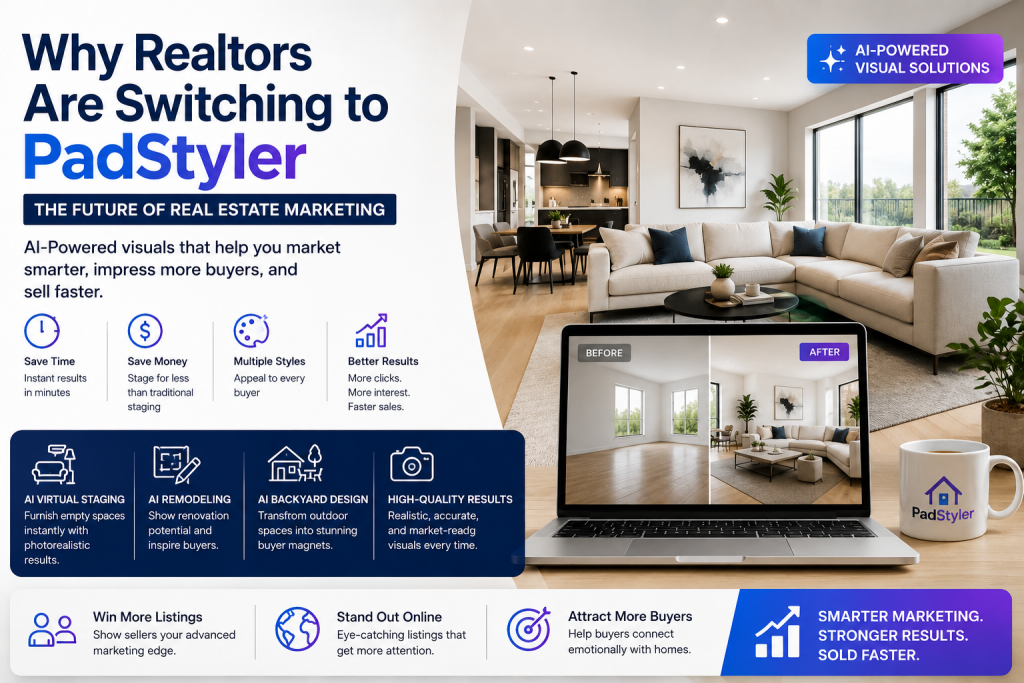
Why Realtors Are Switching to PadStyler: The Future of Real Estate Marketing

The real estate industry is changing faster than ever.

Today’s buyers are no longer walking into every open house in their neighborhood. Instead, they are scrolling through listings online, comparing properties in seconds, and making decisions before ever contacting an agent.

That shift has completely transformed how homes are marketed.

In a digital-first market, presentation is everything. A property with poor visuals can be ignored instantly, while a beautifully presented listing can generate more clicks, more inquiries, and faster offers.

This is exactly why more realtors are moving toward AI-powered real estate marketing platforms like PadStyler.

From AI virtual staging to remodeling previews and outdoor transformations, modern agents are realizing that traditional marketing methods are no longer enough to compete. Speed, affordability, flexibility, and high-quality visuals are becoming essential tools for winning listings and closing deals faster.

The future of real estate marketing is no longer physical staging trucks, expensive furniture rentals, and week-long turnaround times.

The future is AI-driven visualization.

And realtors everywhere are adapting quickly.

The Modern Real Estate Buyer Has Changed

The first showing no longer happens in person.

It happens online.

Buyers now make emotional decisions based on listing photos viewed on platforms like Zillow, Realtor.com, Instagram, Facebook, and brokerage websites. If the photos fail to create interest immediately, most buyers simply move on to the next property.

According to information published by PadStyler AI, staged homes help buyers better visualize a property as their future home, often resulting in faster sales and stronger buyer engagement. (padstyler.com)

This shift has created a major challenge for agents:

How do you make every listing look visually compelling without spending thousands of dollars on traditional staging?

That is where AI-powered platforms are changing the game.

Traditional Home Staging Is Expensive and Slow

For years, traditional staging was considered the gold standard in property marketing.

Agents hired staging companies to physically furnish empty homes with rented furniture and décor. While effective, the process created several problems:

  • High staging costs
  • Scheduling delays
  • Furniture transportation
  • Limited design flexibility
  • Long setup timelines
  • Expensive revisions
  • Additional photography costs

For luxury homes, staging costs can easily reach thousands of dollars per property.

For many agents, especially those handling multiple listings each month, that approach simply isn’t scalable anymore.

Modern realtors need solutions that are:

Traditional Marketing Problems What Realtors Need Today
Expensive staging fees Affordable marketing
Slow turnaround times Instant results
One design style Multiple buyer-focused styles
Manual revisions Fast AI editing
Complex coordination Simple workflows
Limited scalability Bulk listing support

This demand for efficiency is one of the biggest reasons agents are switching to AI real estate marketing platforms.

Why AI Virtual Staging Is Exploding

AI virtual staging allows agents to digitally furnish and redesign properties using artificial intelligence.

Instead of physically moving furniture into a home, agents can upload property photos and generate fully staged interiors within minutes.

Platforms like PadStyler AI Virtual Staging provide tools that help agents instantly transform empty spaces into realistic, professionally designed rooms. (padstyler.com)

This changes everything.

Now agents can:

  • Stage vacant homes instantly
  • Create multiple design styles
  • Appeal to different buyer demographics
  • Market listings faster
  • Reduce staging expenses
  • Improve online engagement
  • Test different visual approaches

More importantly, AI staging allows agents to compete at a higher level without increasing marketing budgets.

Realtors Need Speed More Than Ever

In today’s competitive market, speed matters.

The faster a listing goes live, the faster buyers see it.

Traditional staging can delay listings for days or even weeks. AI-powered staging can produce marketing-ready visuals almost instantly.

PadStyler highlights instant staging workflows designed specifically for agents who need faster listing preparation and scalable solutions. (padstyler.com)

That speed creates a major advantage.

Faster Listings Mean:

  • Faster market exposure
  • More online visibility
  • Faster buyer inquiries
  • Better listing momentum
  • Reduced vacancy time
  • Higher agent productivity

For busy realtors managing multiple properties, this efficiency becomes extremely valuable.

AI Helps Buyers Emotionally Connect With Properties

Empty rooms rarely inspire buyers.

Most buyers struggle to imagine how furniture will fit into a space or how a room could actually look once furnished.

Virtual staging solves that problem.

Beautifully designed spaces help buyers emotionally connect with a home before they ever visit it in person.

This emotional connection often increases:

  • Click-through rates
  • Showing requests
  • Social media engagement
  • Buyer interest
  • Perceived property value

PadStyler Portfolio notes that enhanced listings can generate significantly more clicks and buyer engagement compared to empty listing photos. (padstyler.com)

That online attention directly impacts lead generation for agents.

Modern Realtors Want Multiple Design Styles

One of the biggest advantages of AI-powered staging is flexibility.

Traditional staging usually limits a property to one design style due to cost and logistics.

AI staging changes that completely.

Agents can now create multiple looks for the same room, including:

  • Modern interiors
  • Luxury aesthetics
  • Scandinavian designs
  • Farmhouse themes
  • Minimalist spaces
  • Family-friendly layouts
  • High-end contemporary styling

This allows agents to market the same property to different buyer personas without additional staging costs.

For example:

Buyer Type Preferred Style
Young professionals Modern minimalist
Families Warm and functional
Luxury buyers Elegant contemporary
Investors Clean neutral staging
First-time buyers Cozy approachable interiors

This personalization helps listings connect with broader audiences.

AI Remodeling Is Creating New Opportunities

Buyers often struggle to see the potential in outdated homes.

An old kitchen, worn flooring, or outdated backyard can reduce buyer interest immediately.

That is why AI remodeling previews are becoming extremely popular.

PadStyler AI Remodeling allows agents to visualize renovations digitally before any physical work is completed. (padstyler.com)

Instead of showing buyers a dated property, agents can show:

  • Renovated kitchens
  • Modern bathrooms
  • Updated flooring
  • New paint concepts
  • Backyard transformations
  • Outdoor entertainment areas

This helps buyers focus on possibility instead of current imperfections.

Outdoor Visualization Is Becoming a Competitive Advantage

Exterior spaces matter more than ever.

Backyards, patios, pools, gardens, and outdoor entertainment areas are now major selling points for many buyers.

AI-powered backyard design tools help agents market outdoor spaces more effectively.

PadStyler AI Backyard Design enables agents to create realistic landscaping and outdoor design previews that help buyers visualize a property’s full potential. (padstyler.com)

This is especially powerful for:

  • Luxury homes
  • Vacation properties
  • Family homes
  • Outdoor entertainment spaces
  • New construction projects

Outdoor visualization can dramatically improve listing appeal online. Continue reading


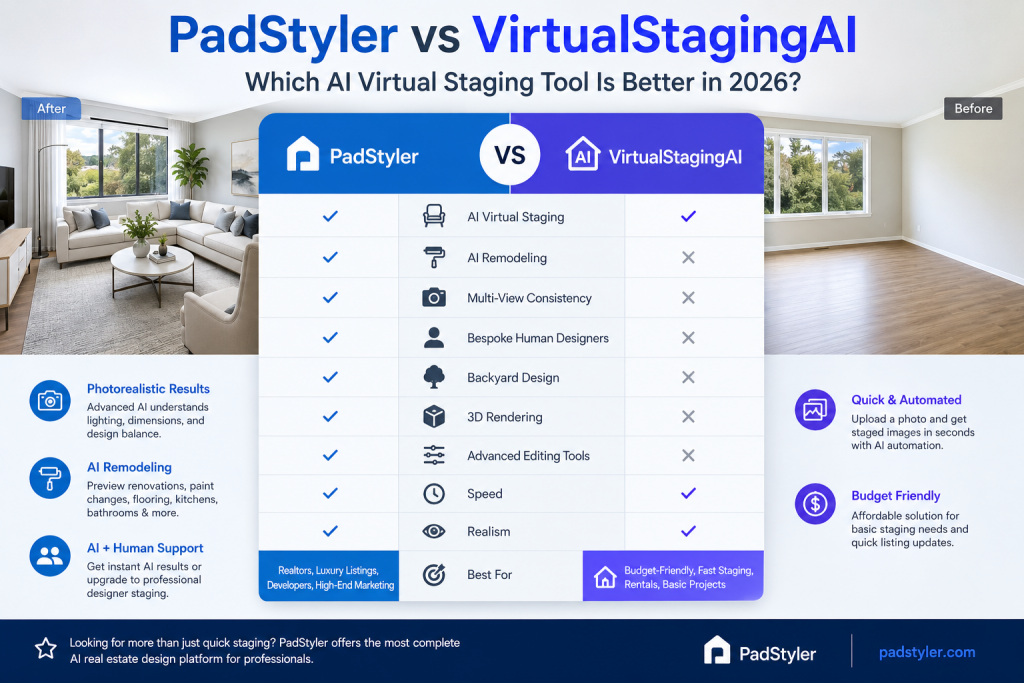
PadStyler vs VirtualStagingAI: Which AI Virtual Staging Tool Is Better in 2026?


The demand for AI-powered virtual staging has exploded in real estate. Agents, photographers, property managers, and home sellers are all looking for faster and more affordable ways to transform empty spaces into attractive listing photos.

One platform that often comes up in conversations is VirtualStagingAI. But many real estate professionals are now searching for a better alternative that offers more realistic designs, advanced editing tools, and flexible staging options.

That’s where PadStyler comes in.

In this comparison, we’ll break down the differences between VirtualStagingAI and PadStyler so you can decide which platform is best for your real estate marketing needs.

What Is VirtualStagingAI?

VirtualStagingAI is an AI-powered staging platform designed to help users quickly furnish empty rooms using artificial intelligence. The platform is known for its speed and low-cost automated staging. Many users choose it because they can upload a room photo and receive staged images within seconds. (Reddit)

The platform works well for:

  • Fast property listings
  • Rental properties
  • Budget-friendly staging
  • Simple room transformations

However, many users also mention limitations with realism, consistency, and room accuracy when compared to higher-end solutions. (Reddit)


Why Realtors Are Looking for a VirtualStagingAI Alternative

AI staging tools are becoming more competitive every year. Realtors now want more than just quick furniture placement.

Today’s agents need:

  • Photorealistic results
  • MLS-friendly images
  • Consistent staging across multiple room angles
  • Better furniture scaling
  • Remodeling previews
  • Advanced editing controls
  • Human-quality finishes

Some Reddit users noted that cheaper AI staging tools can sometimes create unrealistic furniture placement or alter room structures unexpectedly. (Reddit)

This is why many professionals are switching to more advanced platforms like PadStyler.


What Makes PadStyler Different?

PadStyler AI is an all-in-one AI real estate design platform built specifically for real estate professionals.

Unlike basic AI staging tools, PadStyler combines:

  • AI virtual staging
  • AI remodeling
  • AI backyard design
  • Bespoke human-designed staging
  • 3D rendering services
  • Multi-view staging consistency

According to PadStyler, their platform is designed for agents, photographers, and designers who need realistic staging with speed and scalability. (padstyler.com)


PadStyler vs VirtualStagingAI Comparison

Feature PadStyler VirtualStagingAI
AI Virtual Staging Yes Yes
AI Remodeling Yes Limited
Multi-View Consistency Yes Limited
Bespoke Human Designers Yes No
Backyard Design Yes No
3D Rendering Yes No
Advanced Editing Tools Yes Basic
Speed Instant Instant
Realism Highly realistic Good for quick staging
Best For Realtors, luxury listings, developers Budget-friendly quick staging

1. Better Image Realism

One of the biggest complaints about low-cost AI staging tools is unrealistic furniture placement or “AI-looking” results.

PadStyler focuses heavily on photorealistic outputs. Their AI understands:

  • Lighting
  • Room dimensions
  • Furniture scaling
  • Interior design balance

The company also offers optional human quality control for premium results. (padstyler.com)

This makes PadStyler especially useful for:

  • Luxury listings
  • High-end real estate marketing
  • MLS-ready photos
  • Developer presentations

2. AI Remodeling Features

Most AI staging platforms only add furniture.

PadStyler goes much further with AI remodeling tools that can preview:

  • Kitchen renovations
  • Bathroom upgrades
  • Flooring replacements
  • Paint changes
  • Backyard transformations

This is a huge advantage for:

  • Investors
  • House flippers
  • Remodelers
  • Builders
  • Realtors marketing fixer-uppers

The ability to show buyers renovation possibilities can significantly increase buyer engagement.


3. Multi-View Room Matching

One major issue with many AI staging platforms is inconsistency between room angles.

For example:

  • One image may show a gray sofa
  • Another angle may suddenly show a completely different setup

PadStyler’s multi-view staging system helps maintain design consistency across multiple room photos. (padstyler.com)

This creates:

  • More professional listing presentations
  • Better buyer trust
  • Cleaner MLS galleries

Continue reading


Realtor Marketing Tips: How AI Virtual Staging Is Changing Real Estate Marketing


The real estate industry has become more competitive than ever. Buyers no longer begin their home search by driving around neighborhoods or checking newspaper ads. Today, almost every buyer starts online. They scroll through property listings, compare homes, and make decisions based on photos before they ever contact an agent.

This means one thing for realtors: first impressions matter more than ever.

If a property looks empty, outdated, or poorly presented, buyers may skip it within seconds. But when a listing features beautiful, professionally styled interiors, buyers are more likely to click, explore the photos, and schedule a viewing.

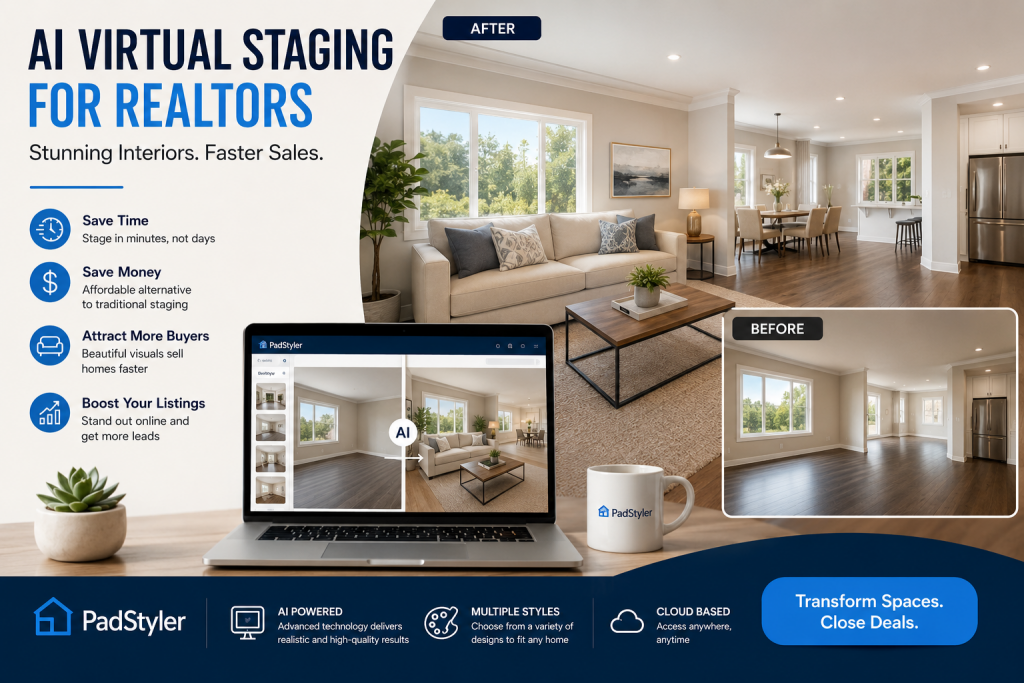
That is why many real estate professionals are now using ai virtual staging to improve their marketing results. Artificial intelligence has made it possible to transform empty rooms into modern, fully furnished spaces quickly and affordably.

With platforms like PadStyler, agents can create stunning listing visuals without spending thousands on traditional home staging.

In this guide, we’ll explore practical realtor marketing tips and explain how Virtual Staging AI is helping agents attract buyers, generate leads, and sell homes faster.


Why Real Estate Marketing Has Changed

Real estate marketing is no longer just about putting a sign outside a property. The modern buyer expects high-quality online experiences.

When people search for homes online, they often compare dozens of listings in a short amount of time. The listings with the best visuals usually get the most attention.

Professional marketing helps realtors:

  • Attract more buyers
  • Build trust with sellers
  • Increase online visibility
  • Sell homes faster
  • Improve brand reputation
  • Generate more referrals

The challenge is that traditional marketing methods can be expensive and time-consuming. Professional photography, physical staging, and home preparation all require significant investment.

This is why AI Powered Virtual Staging is becoming one of the most valuable tools for modern real estate agents.


What Is AI Virtual Staging?

ai virtual staging is a technology that uses artificial intelligence to digitally decorate and furnish property photos.

Instead of physically bringing furniture into a home, AI software analyzes a room image and adds realistic furniture, décor, lighting, and design elements digitally.

Using tools like PadStyler, agents can:

  • Furnish empty rooms
  • Redesign interiors
  • Create modern styles
  • Improve lighting and presentation
  • Generate attractive listing photos

The process is simple, fast, and much more affordable than traditional staging.


Why Realtors Are Switching to Virtual Staging AI

Buyers Make Decisions Quickly

Online buyers decide within seconds whether they want to continue viewing a listing.

If the property photos are unattractive, dark, or empty, buyers often move on immediately.

Using Virtual Staging AI, realtors can create warm, welcoming spaces that capture attention instantly.

Beautiful visuals help buyers:

  • Feel emotionally connected
  • Understand room layouts
  • Imagine living in the property
  • Stay longer on listings

This can dramatically improve engagement.


Traditional Staging vs AI Powered Virtual Staging

Traditional staging has been used in real estate for years. While it can be effective, it also comes with challenges.

Traditional staging often includes:

  • Furniture rental costs
  • Delivery charges
  • Interior designer fees
  • Setup and removal time
  • Scheduling complications

In comparison, AI Powered Virtual Staging offers a faster and more affordable solution.

Traditional Staging AI Powered Virtual Staging
Expensive Budget-friendly
Requires physical furniture Fully digital
Takes days or weeks Ready in minutes
Limited style flexibility Multiple styles instantly
Difficult for multiple listings Easy to scale

For busy agents, AI staging offers a practical way to market properties professionally without large expenses.


Realtor Marketing Tips Using AI Virtual Staging


1. Focus on Strong Listing Photos

Property photos are the heart of online real estate marketing.

Before using Virtual staging AI real estate tools, make sure the original photos are high quality.

Tips for better photos:

  • Use natural lighting
  • Clean every room
  • Remove clutter
  • Use wide-angle shots
  • Keep image quality high

Better photos create more realistic staging results.


2. Stage the Most Important Rooms First

Not every room needs virtual staging.

Focus on the spaces buyers care about most:

  • Living rooms
  • Primary bedrooms
  • Kitchens
  • Dining spaces
  • Home offices

These rooms create the biggest emotional impact.


3. Match the Style to the Target Buyer

Different buyers prefer different interior styles.

For example:

  • Young professionals may like modern minimalist designs
  • Families often prefer cozy and functional interiors
  • Luxury buyers expect elegant styling

Using Stager ai tools allows agents to customize the staging style based on the property and audience.

This makes listings feel more relatable and attractive.


4. Use Before-and-After Content

Before-and-after staging images perform extremely well online.

These comparisons help people understand the power of staging and create strong visual impact.

You can use before-and-after visuals in:

  • Social media posts
  • Facebook ads
  • Instagram reels
  • Email marketing
  • Seller presentations

This strategy also helps attract future clients who want better marketing for their homes.

Continue reading


The Definitive Guide To 3D Architectural Rendering

3D architectural rendering is an essential tool for architects in modern times.

This is due to the advancement in technology that has allowed them to make designs with more ease. In the olden days, plans would have to be done by hand on blueprints which would lack efficiency and accuracy. Additionally, this would make them harder to rectify as well. 3D rendering has been a blessing for many industries, especially architects. It allows their measurements and proportions to be as accurate as possible. This enables them to visualize their work in advance before it is implemented.


However, 3D architect rendering is not without its challenges. Some of these challenges require a lot of practice, creative skill, technological prowess, and the need to implement a convincing design. In this guide, we will talk about everything you need to know about 3D architectural rendering.

Let’s dive in.

Table of Contents

  1. Understanding Types of 3D Rendering
  2. Understanding Potential Problems
  3. Rendering Techniques
  4. Post-Production


1. Understanding Types of 3D Rendering

Before diving into the details, it is vital to understand the types of 3D rendering. This is to avoid any confusion once we begin understanding how it works. Understanding this will also help you avoid any awkward interview moments where interviewers may ask you basics. By knowing the types of 3D rendering, you can ensure such a scene does not occur and become part of their 3D architectural rendering services.


The two main types of 3D rendering are offline rendering and real-time rendering. Let’s try and understand what each of these is.

Offline rendering refers to when frames are rendered in the form of a still image or sequences of images. It is generally used by architects who want to create photorealistic designs that catch the eye of audiences. You may have often seen such images as concept designs in front of construction sites. The point of these images is to show off as much potential of the plan. Additionally, it must also look realistic so that it looks convincing. The main priority of offline rendering is quality and does not focus on other aspects. Lighting and shading are some examples of offline rendering elements which we will talk about later.

Real-time rendering is another visualization technique that relies on moving images that give the impression of animation. These images are loaded rapidly, giving the effect of real-time movement. You can use it to provide a more detailed appearance of architectural designs. For example, a complex revolving design for a door may be shown more accurately through real-time rendering than offline rendering. Real-time rendering can also help impress clients, which makes it a helpful tool for architects.


2. Understanding Potential Problems

While 3D rendering does bring a lot of advantages and benefits to the table, it also brings potential challenges. It is essential you first understand these challenges before we dive into rendering techniques so you can have a firmer grasp on the topic.

One common mistake that architects tend to make is failing to understand the basic details of the design. This can be anything from floor plans to furniture plans during, for example, 3D apartment rendering. If there is a mistake made during this part, it can cause a lot of hiccups in the whole process. This can lead to disgruntled higher-ups or clients, which may require you to reevaluate the design. In this way, a lot of time and effort may end up being wasted.


Another problem arises with the choice of 3D rendering software. There are many software options out there, but it is impossible to choose all of them. You will have to narrow down the options based on various factors such as cost and features. It can be helpful to avail free trials so that you can get a feel for them and choose which one is ideal for you. It would help if you were on the lookout for standard plug-ins: forest packs, floor generators, and vray options, among others. Some of the cheaper software options may not have these advanced features, so you must evaluate all these factors. Keep in mind that you may be rendering various models, such as 3D building rendering.

Now that you have understood the potential problems, we will look at the nitty-gritty details of the actual work or techniques of 3D rendering.


3. Rendering Techniques

This is where we talk about the actual work that is involve in 3D architectural rendering. We will be looking at the basic techniques that go into 3D rendering and newer methods that are getting popular. Understanding these techniques separately will ensure you get a good grasp of them so you can see how they come together to create a 3D model.

Modeling is the first step of any 3D rendering process. The more effort you put into this part of the process, the higher your final rendering’s value. This means adding as much detail as you can to ensure a high level of photorealism. We recommend investing a high percentage of your time in this process.

Textures are another basic yet essential component of 3D rendering. You must pick the right textures for your model to ensure a high level of realism. Otherwise, even if you add a high amount of details to your model, the final render may fail to deliver because of unsuitable textures. It would help if you chose textures that suit the render to make sure the final product provides. You must consider perspective and angles to show off the perfect texture of the final render. Using high res images will also add value to your textures.


The setting is another vital aspect of your render. This involves choosing the perfect backdrop as well as light settings. Lighting is critical for the final presentation of your render, as the lighting and shadow effects make it look realistic and convincing. Having a neatly prepared file can help during this process because you will probably be making many changes. Learning how to choose the appropriate setting can’t generally be define by a set of rules as each model will be different and will require different ones. This is something only experimenting and experience will teach you. An experienced architect can realize what lighting and perspective to choose almost immediately. It is important to note here that you should be wary of reflections. If your model displays metallic objects, then the reflections should be according to the material. If your reflections look off, the final render will not look convincing.

Ray tracing is a more modern feature of 3D rendering software, such as Chaos Vray. Ray tracing refers to the process whereby the software will generate an image by tracing rays of light from a virtual camera and then simulating the effect based on how they interact with various objects. This can involve shadow formation as well. It is an effective technique that can be used to form photorealistic images quite quickly.

A combination of these techniques results in a final render that will give us the final image that we are used to seeing in concepts after post-production. We will discuss post-production in the next chapter.


4. Post Production

Once you have completed the rendering, it is time to add the final touches. This is post-production. The final raw render that you will generate may often have minor flaws that need to be rectified.

Post-production changes could be anything from colors and details that may need to be touched up. Sometimes, bigger changes will require, such as changing the perspective to improve the final product even more. Some of the elements you may change up may include grass, trees, background, and location. Brightness, shadows, and color contrasts are other features that you may tweak.


Wrapping up

3D Architectural Rendering is a handy tool for architects as it brings in a lot of ease and benefits for them. However, this is not without its problems, as you have seen some of them outlined in this guide. Various techniques are involved in 3D architectural rendering, and we have highlighted the important ones to get the complete picture that this process involves. We hope this guide has been helpful and informative.

We look forward to seeing you diving into 3D architectural rendering and thriving at it.


25 Best Architecture Blogs You Should Be Following In 2021

25 Best Architecture Blogs You Should Be Following In 2021 – Padstyler

There are so many great architecture blogs that it can be hard to know where to start. That’s why we’ve compiled a list of the best architecture blogs you should be following in 2021. This list includes everything from design and construction projects to tips for living in an eco-friendly home. Whether you’re looking for inspiration or want to see what other architects have been up to recently, here’s the list we have compiled of 30 blogs that will keep your finger on the pulse of what’s new in this constantly changing industry.

25 Best Architecture Blogs You Should Be Following In 2021

Following is the list of 25 Best Architecture Blogs You Should Be Following In 2021:

Decoist

decoist.com
Decoist is a blog that focuses on bringing you the latest unique design ideas and inspiration worldwide. The best thing about Decoist is that it’s very user-friendly, making it easy to find new exciting details and outstanding designs to incorporate into your own home.
Decoist features all sorts of ideas to make your bathrooms, bedrooms, kitchens, or offices look prettier. They bring you furniture and lighting ideas, houses everyone would dream of, and luxury properties that defy the world crisis.

The Design Files

thedesignfiles.net
The Design Files is Australia’s most popular design blog. They cover real Australian homes, gardens, art, architecture, craft, interior design, furniture, textiles, homewares, food, and much more!
Founded by Melbourne stylist Lucy Feagins in 2008, over the past 11 years, The Design Files has grown and built an excellent, highly engaged community of readers and social media followers.
The Design Files hosts regular art exhibitions, events, talks, and pop-ups outside of the web. We also have a weekly column in Domain magazine (The Age / Sydney Morning Herald).

e-architect

e-architect.com
e-architect is an award-winning online magazine focusing on architecture and design. The blog features a wide range of topics concerning the industry, from small business advice to home renovations and eco-friendly methods.
e-architect is an excellent resource for learning about architecture at all scales and styles. The articles on the site are not just images; they have interviews with the architects and photographers that make them unique.

The Architecture Designs

thearchitecturedesigns.com
This is an online media outlet acting as a platform where people can explore and learn about new and various architecture schools and all sorts of collections and trivia involving architecture. This broad-spectrum includes the latest fence designs and innovative ideas for structuring and furnishing a basement bar.

They regularly publish articles for our valued subscribers and readers willing to learn more and broaden their perspectives on the subject. They also have our meticulously curated database of ideas on home refurbishments, gardening and beautification projects, home decorations for occasions, and architecture, both interior and exterior, also including a bit of terraforming and landscape designing.
The blog has a professional touch, so it’s perfect for gaining inspiration and learning about upcoming projects.

Visualizing Architecture

visualizingarchitecture.com
Visualizing Architecture is a blog that originally started as an experiment in interacting with the built environment. Founders Joanne Tan and Mai Yee started this website for everyone who wanted to learn more about architecture without taking the traditional route of going through formal training. It’s also a great site for young students who want to get into the industry. The blog is updated frequently with articles on architecture and has become a one-stop-shop for anyone interested in the built environment.

The website also hosts an annual event called Visualizing Architecture Hackathon, where students come together to do research directly related to housing problems around the world. These articles and projects also give students exposure to the real world and get involved with architecture. Visualizing Architecture has already been awarded a few times for its projects, including winning the People’s Choice Award in 2014 at the World Architecture Festival Awards.

The blog also has an awesome series called Lost Architecture, which showcases some of the most interesting buildings destroyed or demolished throughout the history.

Unhappy Hipsters

unhappyhipsters.com
Unhappy Hipsters covers everything about home decor, home financing, interior design, architecture, DIY project, and gardening.
This blog was started in 2012 by a group of anonymous architects, designers, planners, and people who work in the industry. It’s a source of interesting news about architecture and urban planning. When it comes to content, Unhappy Hipsters deliver practical examples that show how people can use the built environment to live happier lives and encourage us all to think not only about what exactly we want but how it can actually happen.
The blog is also a great source of inspiration for people who aren’t necessarily working in the industry but would still like to know more about architecture and urban planning.

Designboom

designboom.com
Designboom is based in Milan, Beijing, and New York and has gained a global reach of 3.5 million readers and 450,000 newsletter subscribers.

Designboom aims to bring together professionals and young creatives from a diverse range of backgrounds. By publishing the latest news and key issues in the fields of architecture, design, technology, and art, their mission over the past 20 years has remained the same: unearthing the best projects and curating a selection of the most interesting aspects of contemporary culture before people can find it anywhere else.

Today, designboom is a comprehensive source with over 50,000 articles worth of useful information and insightful interviews, studio visits, documentation of new products, reviews of exhibitions, books, and historical surveys.

Young Architects

youngarchitect.com
Young Architect was founded in 1980 and is now the website of over 73,000 architects. It’s a great place to learn about architecture, from how to get into an architecture career to amazing buildings around the world.
The blog’s aim is simple: to allow students and young professionals interested in architecture to understand what it really takes beyond reading books. To do this, they discuss real-life issues and scenarios that people interested in architecture face on a day-to-day basis.

ArchSmarter

archsmarter.com
If you’re interested in design and architecture, you need to follow ArchSmarter. The blog offers a wide variety of design information, including interior design, modernist furniture, colors for your house, decor trends, and more.

The blog was founded in 2011 and has had over 100 posts so far. The blog’s founder is a self-taught architect, writer, and photographer whose goal is to provide the best of architecture, design, and interiors on one site.

If you want to see innovative buildings, read interviews with famous designers or get advice for remodeling your own home, ArchSmarter is a great resource to follow. The site’s content is published in English, Chinese and Korean.

EntreArchitect

entrearchitect.com
EntreArchitecture is an architecture website that has been in the game for over 15 years. The site covers everything from architectural news and design trends to interviews with famous architects and firms, events coverage, schools’ rankings, and even editorial pieces about topics rarely talked about, like sustainability.

EntreArchitecture was created to promote a culture of architecture that puts people at the center. They aim to inform their readers about what’s going on in the world of architecture and how it might affect them and provide them with useful tips for making important design decisions, which is why they often share stories from real clients.

NCARB

ncarb.org
The National Council of Architectural Registration Boards (NCARB) is a nonprofit organization made up of the architectural licensing boards of 55 U.S. states and territories. While each jurisdiction is responsible for regulating architecture practice within its borders, NCARB develops and administers national programs for candidates pursuing architectural licensure and helps architects expand their professional reach through the NCARB Certificate.

NCARB, in collaboration with licensing boards, facilitates the licensure and credentialing of architects to protect the health, safety, and welfare of the public.

It also provides public awareness about the value of professional architects.

The Architect’s Guide

thearchitectsguide.com
The Architect’s Guide is an architecture blog featuring over 10,000 articles and videos. The blog covers all aspects of architecture, art, design, and construction, so you’ll never run out of topics to read about.

The site’s mission is to allow anyone to learn more about these fields no matter how much experience they have with them. They have a great selection of topics from “Understanding the Principal” to Tips for Designing Better Houses and so much more.

Their mission is to provide an online platform for architects, designers, and other design-oriented professionals to showcase their projects and gain recognition while helping others discover home decorating ideas.

RMJM

rmjm.com
RMJM is a global architectural company with over many years of experience in designing and constructing buildings loved by many.
Since RMJM was established in 1956, it has seen (and often participated in) some of the most significant architectural transformations of the last three generations. From 1970s camel racing grandstands in Dubai to terminals in Russia’s busiest airport in 2019, RMJM has worked on some truly unique and iconic projects, including the record-breaking Lakhta Centre, the LEED award-winning Khoo Teck Puat Hospital, and the world’s first and only rotating boat lift, the Falkirk Wheel.

The blog was founded in 2012 and offers architecture news, design trends, construction updates, and other useful information for anyone interested in architecture.

HMH Architecture + Interiors

hmhai.com
HMH Architecture + Interiors is a leading Colorado design studio guiding people to realize their dreams and create beautiful homes that are functional, very livable and respect the environment.

The firm’s work ranges from high-end residential projects to large institutional, commercial, mixed-use developments. They design custom residences for clients seeking unique architectural environments that are both beautiful and functional.

Archute

archute.com
Archutech is an online platform that provides a place for people, from both the east and west, to share everything related to new technologies that could improve the architectural design.
The website’s mission is to provide a collaborative tool where designers can have access to early-stage technology projects and equally help develop ideas through feedback.
The blog features daily updates of the latest and greatest technological developments in architecture. If you’re looking for some inspiration, this blog can provide it by providing information about the coolest buildings in construction and what they are made of.

Number TEN Architectural Group

numberten.com
A magazine dedicated to promoting and encouraging the practice of sustainable architecture, Number Ten was established in 2001 to open up discussion around sustainability issues. Today, it is one of the most widely read online publications on the subject.

Number TEN’s blog covers a wide range of architecture and design topics, from the birth of the cubist movement to the latest from NHK’s “Architecture Studio.” The blog features architectural critique, interviews with architects like Peter Zumthor and MVRDV, as well as personal musings about the latest in architecture and design. It is a good resource for those interested in all things related to structure.

CADdetails

caddetails.com
Founded in 1997, CADdetails is the leading provider of manufacturer-specific building product information, delivering high-quality planning documents to architects, engineers, contractors, and other design industry professionals throughout North America.


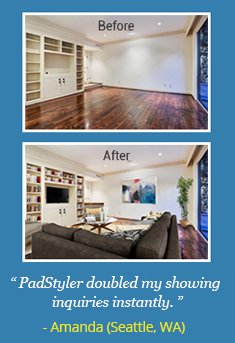

While CADdetails is a leading website for CAD users, the blog also covers a wide range of topics related to architecture. CAD details provide free tutorials and guides on SketchUp, AutoCAD, and Revit. There are also articles about the latest technological advances in 3D design.

Now and then, you may find the content less related to CAD, such as articles about famous architects and their most daring designs.

Wolf Architects

wolfarchitects.com.au
Wolf Architects is a small, highly specialized firm that calls Australia home. Their blog covers all topics related to architecture and design. Wolf Architects cover the latest trends in design and interviews with leading professionals such as David Adjaye. Learn about how some of the best architects approach their projects and where they get their inspiration from.

Founded in 2000, Wolf Architects is a design studio based in New York specializing in residential projects. Wolf Architects regularly shares design concepts, construction tips, useful advice for new architects, and articles about the latest news from the industry to its followers on its website and blog.

Homedit

homedit.com
Homedit.com is a home-focused website that provides inspiration and information about design, style, décor ideas to help readers visualize their dream homes. They believe in the concept of individuality, which is why they provide plenty of beautiful photos on their platform for viewers to get creative with designing an inspiring interior space personalized just for them!
Having a home of your own is one thing, but having an attractive and well-designed place to call “home” is something else. Homedit’s mission statement says that its goal is to help readers design beautiful homes with tons of articles on architecture, interior decorating ideas and DIY projects. They have 180k photos across 16k unique articles, which are both diverse in content as they cover everything from furniture choices to color schemes!

CAANdesign

caandesign.com
CAANdesign Was founded on 1st March 2013.
The website, first of all, create by a student who is passionate about interior design and contemporary homes. They broadcast full projects to inspire architects or homeowners who would like to change their current residence. The site includes unique designs such as megastructures and houses with ordinary appeal – they have it all covered!

Their mission is to bring architecture into everyday life by broadcasting complete projects intended to give insight on house construction and renovation ideas from some seriously talented people around the globe. If you’re looking for new inspirations, this website has plenty; take your pick since there are many interesting things related to interior design and architectural buildings that span different styles, including modernistic ones.

ArchEyes

archeyes.com
ArchEyes was founded in 2016 as a research Architecture blog between young architects and friends. After just a few months, the blog started receiving attention from prominent architecture critics and was featured in The Guardian and the New York Times articles. Since then, growth has been exponential year after year, with their own Alexa rank reaching Top 100K worldwide by 2020 – that’s not all! They’ve received several awards during this time, such as the THA Design & Architecture Award (2020) or the A´Best Media Awards for Best Blogs of 2019.

ArchEyes is an award-winning international site that provides its users with quality information about current architectural trends worldwide via commentary on live projects from notable industry professionals who specialize in design criticism to provide our readers.

Architecture Ideas

architecturesideas.com
Architecture Ideas is an ever-growing blog that’s been around since 2008. While the blog’s content can range from contemporary architecture to urban design issues, all the ideas have one primary focus: Architecture. This blog allows its readers to explore the world of architectural photography and graphic design with a global outlook. Architecture ideas aim to attain maximum followers who take ideas from their website and build their architecture. They publish constant original design, architecture, luxury houses, or workplace-related content for them to be a go-to destination for anyone passionately looking for creative inspiration. You can contact them if you need personalized advice on your home/office building needs with the help of experts they’ve got at hand.

DesignRulz

designrulz.com
Designrulz.com was established in September 2009 with a mission that provides complete information for architects worldwide every week, every day, soon after it happened.

This is an online information resource for architecture enthusiasts and professionals alike as there are thousands of designers worldwide who can’t keep up to date on all their favorite news sources any longer, so Designrulz serves them well by providing quick access to high-quality content from top design blogs and websites across multiple disciplines like production or expression.
The site operates as an online resource that features high-quality works of design from all over the world in tune with aesthetic principles such as beauty or significance according to critics’ standards.

ArchitectureQuote

architecturequote.com
ArchitectureQuote, a real estate property building construction company, aims to provide all those entrepreneurs who will build their dream home with valuable information on how to get an architect’s quote for building a property effectively. This site is basically for those interested in knowing more about architecture work and the process of getting an architect’s quote for erecting a property, and how to find the best architects by using quotes.

Arcmax Architects

arcmaxarchitect.com
Arcmax Architects is an architecture and interior design firm located in Mumbai, India. ArcMax Architects and Planners is a multinational architectural firm known for delivering excellent solutions through its team of industry-leading professional architects.

They have been providing Architecture, Design Planning, Interior designing, and Architectural Solutions that are innovative Creative memorable since inception. With years of experience in the field And Industry knowledge they’ve gained from around the world, Arcmax delivers impressive results with every project they undertake.

The designs are innovative and sustainable. They have been designing residential, commercial, and institutional projects for over 30 years now.

Bottom line:
The architecture industry is evolving rapidly and staying competitive, and you need to keep up with the latest news. We want to help by providing a list of 25 blogs covering various aspects of architecture in depth. You can’t go wrong following these architects on their respective sites or social media channels. These blogs cover information about what they are working on and other inspiring content related to design trends, development, and construction techniques.