 The real estate industry is rapidly embracing PadStyler AI Virtual Staging as a smarter, faster, and more cost-effective alternative to traditional home staging. As property sellers, real estate agents, and investors search for innovative ways to market listings in 2026, the comparison between AI virtual staging and traditional home staging has become more important than ever. Understanding the complete cost breakdown of both approaches can help professionals make informed decisions that maximize property appeal while minimizing expenses. Whether you are marketing a luxury home, an investment property, or a vacant listing, choosing the right staging solution can significantly impact buyer engagement and overall return on investment.
Understanding the Evolution of Home Staging in 2026
Home staging has always been an essential part of real estate marketing. For decades, traditional home staging involved physically furnishing a property with rented furniture, decorative accessories, artwork, and other design elements to make a home appear more attractive to buyers. The goal was simple: help buyers visualize themselves living in the space.
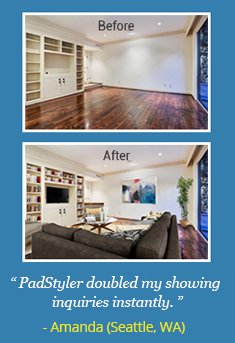
As technology has advanced, the industry has experienced a significant transformation. Artificial intelligence now enables real estate professionals to digitally furnish empty spaces with photorealistic furniture and décor. PadStyler AI Virtual Staging represents this next generation of property marketing, offering realistic staged images without the logistical challenges associated with physical staging.
In 2026, AI-powered solutions have become increasingly sophisticated, producing high-quality visuals that are nearly indistinguishable from traditionally staged rooms. This evolution has shifted buyer expectations and created new opportunities for real estate professionals looking to streamline their marketing efforts.
What Is PadStyler AI Virtual Staging?
PadStyler AI Virtual Staging uses advanced artificial intelligence algorithms to transform vacant property photos into beautifully furnished interiors. Rather than transporting furniture into a home, AI technology digitally places furniture, rugs, artwork, lighting fixtures, and decorative accessories within existing room photographs.
The process is remarkably efficient. Users upload property photos, select their preferred design style, and receive professionally staged images within a short timeframe. The technology analyzes room dimensions, lighting conditions, architectural details, and spatial layouts to generate realistic interior designs that align with buyer preferences.
Unlike traditional staging, which requires physical labor, furniture rentals, transportation, installation, and ongoing maintenance, PadStyler AI Virtual Staging provides a digital-first solution that significantly reduces both costs and turnaround times.
What Is Traditional Home Staging?
Traditional home staging remains a widely used strategy in real estate marketing. It involves physically furnishing a vacant property using rented furniture and décor items. Professional stagers carefully select furnishings that complement the home’s architecture, target demographic, and market positioning.
The staging process typically includes consultations, furniture delivery, room arrangement, accessory placement, ongoing maintenance, and furniture removal after the property sells. While traditional staging can create impressive in-person experiences, it often involves substantial financial investments and logistical coordination.
In competitive markets, many agents continue to use traditional staging for luxury properties and high-end listings where physical walkthrough experiences play a critical role in influencing buyer decisions.
The Complete Cost Breakdown of Traditional Home Staging in 2026
Traditional home staging costs have continued to rise due to inflation, increased transportation expenses, labor shortages, and growing demand for premium staging services.
The initial consultation typically ranges between $200 and $800 depending on property size and market location. Professional stagers assess the property, develop design plans, and provide recommendations for furniture placement and room optimization.
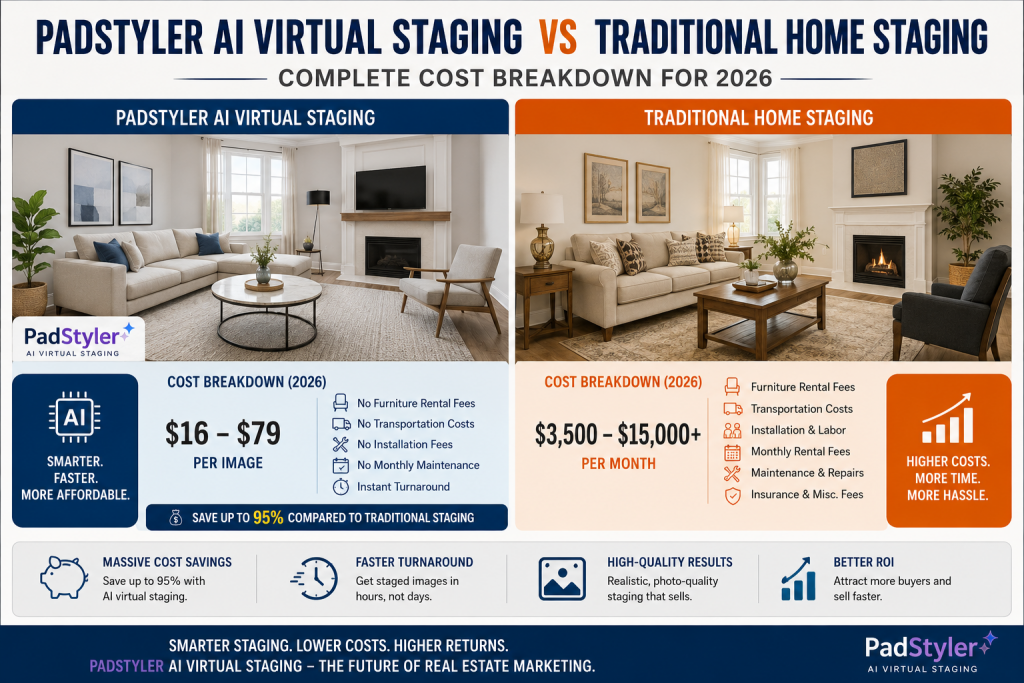
Furniture rental expenses often represent the largest portion of staging costs. For a standard three-bedroom home, furniture rental can range from $2,000 to $8,000 per month. Luxury homes frequently exceed these figures, particularly when designer furnishings are required.
Transportation costs further increase expenses. Delivery trucks, moving crews, installation teams, and logistics coordination can add hundreds or even thousands of dollars to the overall budget.
Many staging companies also charge monthly rental fees for as long as the property remains on the market. If a listing does not sell quickly, ongoing expenses can accumulate significantly over time.
Additional costs may include cleaning services, furniture insurance, repair fees, and furniture replacement charges if items become damaged during showings.
By 2026, the average fully staged home often costs between $3,500 and $15,000 or more depending on location, property size, and staging complexity.
The Complete Cost Breakdown of PadStyler AI Virtual Staging in 2026
PadStyler AI Virtual Staging dramatically reduces many of the expenses associated with traditional staging. Since furniture exists only within digital images, there are no transportation costs, rental fees, installation charges, or furniture maintenance expenses.
Property owners simply upload photos and select desired design styles. AI technology handles the staging process digitally, producing realistic results without requiring physical furniture.
Most AI virtual staging solutions operate on a per-image pricing model. Depending on image quantity and customization requirements, costs typically range from a few dollars per image to premium packages designed for larger portfolios.
Even when staging multiple rooms within a property, total expenses remain significantly lower than traditional staging. Instead of spending thousands of dollars, many listings can be virtually staged for a fraction of the cost.
The elimination of recurring rental fees represents one of the most significant financial advantages. Once staged images are generated, they can be used indefinitely across listing platforms, marketing materials, social media campaigns, and promotional brochures.
Comparing Setup Costs
One of the most noticeable differences between PadStyler AI Virtual Staging and traditional home staging lies in setup expenses.
Traditional staging requires extensive planning, scheduling, furniture procurement, transportation logistics, and labor coordination. Multiple professionals may be involved throughout the process, including designers, movers, warehouse personnel, and installers.
PadStyler AI Virtual Staging eliminates nearly all setup complexities. Property photos can be uploaded immediately, and AI-generated staging can often be completed within hours. This streamlined workflow reduces operational overhead while accelerating marketing timelines.
For agents managing multiple listings simultaneously, the reduction in setup costs can produce substantial annual savings.
Comparing Time Investments
Time is a critical factor in modern real estate transactions. Delays in marketing can result in missed opportunities and longer listing periods.
Traditional staging often requires days or weeks of coordination. Furniture selection, scheduling, transportation, installation, and quality checks all contribute to extended preparation timelines.
PadStyler AI Virtual Staging significantly accelerates this process. Listings can be transformed almost immediately after professional photography is completed. Faster turnaround times enable agents to launch marketing campaigns sooner and attract buyer attention more quickly.
In highly competitive markets, reducing listing preparation time can create meaningful advantages.
Buyer Psychology and Visual Impact
Successful staging is not simply about decorating a property. It is about influencing buyer psychology and helping potential purchasers visualize ownership.
Both traditional staging and AI virtual staging aim to create emotional connections between buyers and properties. Well-designed interiors communicate lifestyle aspirations, functionality, comfort, and value.
PadStyler AI Virtual Staging excels by allowing multiple design styles to be presented for the same property. Agents can target different buyer demographics by showcasing contemporary, minimalist, luxury, farmhouse, or modern interiors based on market preferences.
This flexibility creates personalized marketing opportunities that would be prohibitively expensive using traditional staging methods.
Return on Investment Analysis
Return on investment remains one of the most important considerations when evaluating staging options.
Traditional staging can improve property presentation and potentially increase sale prices. However, the significant upfront investment may reduce overall profitability, especially for lower-priced listings.
PadStyler AI Virtual Staging offers a more favorable cost-to-benefit ratio. Since expenses are substantially lower, even modest improvements in buyer engagement can generate impressive returns.
Many real estate professionals view AI virtual staging as a scalable solution that delivers professional marketing results without excessive financial risk.
Marketing Advantages of PadStyler AI Virtual Staging
Digital marketing has become the foundation of modern real estate sales. Most buyers begin their property search online, making listing photos more important than ever.
PadStyler AI Virtual Staging enhances online listings by creating visually compelling imagery that attracts attention across property portals, websites, email campaigns, and social media platforms.
High-quality staged photos increase click-through rates, improve engagement metrics, and encourage more property inquiries. Since buyers often form first impressions within seconds, visually appealing listings can significantly influence viewing decisions.
The ability to rapidly produce professional imagery also allows agents to respond quickly to changing market conditions and evolving buyer preferences.
Scalability for Real Estate Professionals
Real estate agencies managing large portfolios require scalable solutions that can support multiple listings simultaneously.
Traditional staging becomes increasingly expensive and difficult to coordinate as inventory grows. Furniture availability, scheduling conflicts, and transportation logistics can create operational bottlenecks.
PadStyler AI Virtual Staging offers virtually unlimited scalability. Whether managing ten listings or one thousand, agents can maintain consistent visual quality while controlling costs.
This scalability makes AI staging particularly attractive for brokerages, developers, property managers, and institutional investors.
The Future of Home Staging Beyond 2026
Artificial intelligence continues to reshape real estate marketing. Future innovations are expected to include interactive virtual tours, real-time design customization, augmented reality integration, and predictive buyer preference modeling.
PadStyler AI Virtual Staging is positioned at the forefront of this transformation. As technology advances, digital staging solutions will likely become even more realistic, personalized, and efficient.
The growing adoption of AI across the industry suggests that virtual staging will play an increasingly central role in property marketing strategies throughout the coming years.
Conclusion
The comparison between PadStyler AI Virtual Staging and Traditional Home Staging reveals a clear shift in how real estate professionals approach property marketing in 2026. Traditional staging continues to provide value for certain luxury and high-end listings, but its substantial costs, logistical challenges, and ongoing expenses make it difficult to scale efficiently.
PadStyler AI Virtual Staging offers a compelling alternative by dramatically reducing costs, accelerating marketing timelines, improving scalability, and delivering visually impressive results that resonate with modern buyers. For agents, investors, developers, and homeowners seeking maximum marketing impact with minimal financial investment, AI-powered virtual staging represents one of the most effective real estate technologies available today.
As the industry continues to evolve, PadStyler AI Virtual Staging is becoming more than just a cost-saving tool. It is emerging as a strategic advantage that helps properties stand out in increasingly competitive markets while delivering exceptional value and return on investment.